2
ans
0
cmts
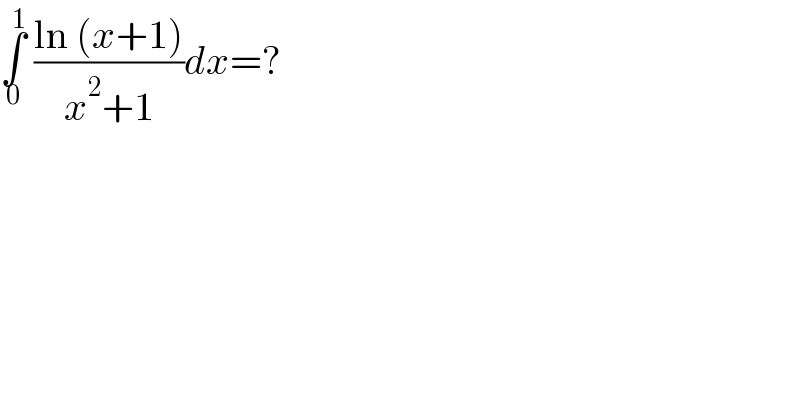
∫_0 ^1 ((ln (x+1))/(x^2 +1))dx=?
0
ans
0
cmts
Question 228881
1
ans
0
cmts
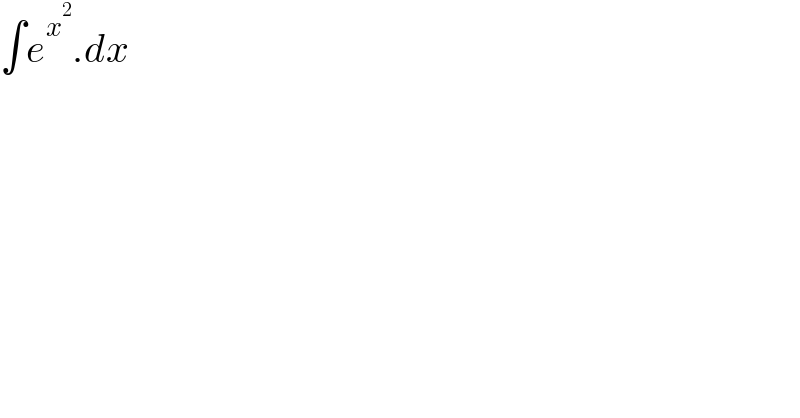
∫e^x^2 .dx
0
ans
2
cmts
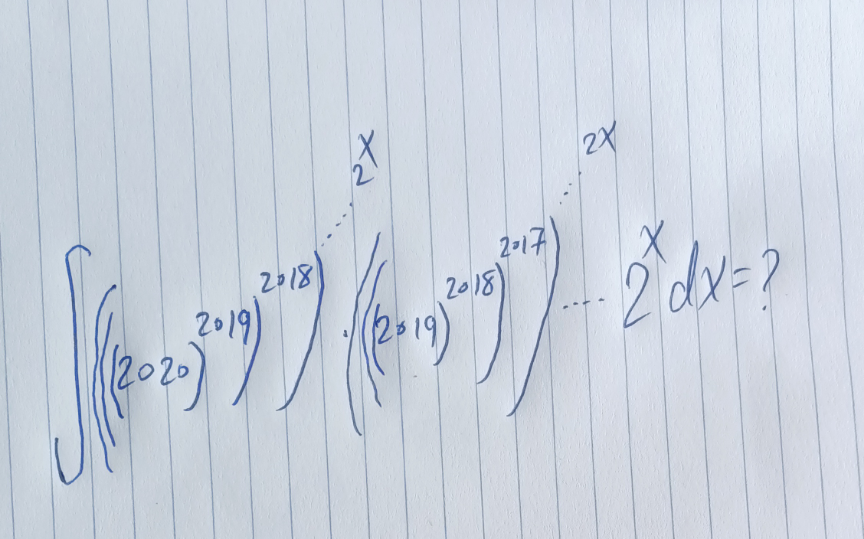
Question 228655
0
ans
3
cmts
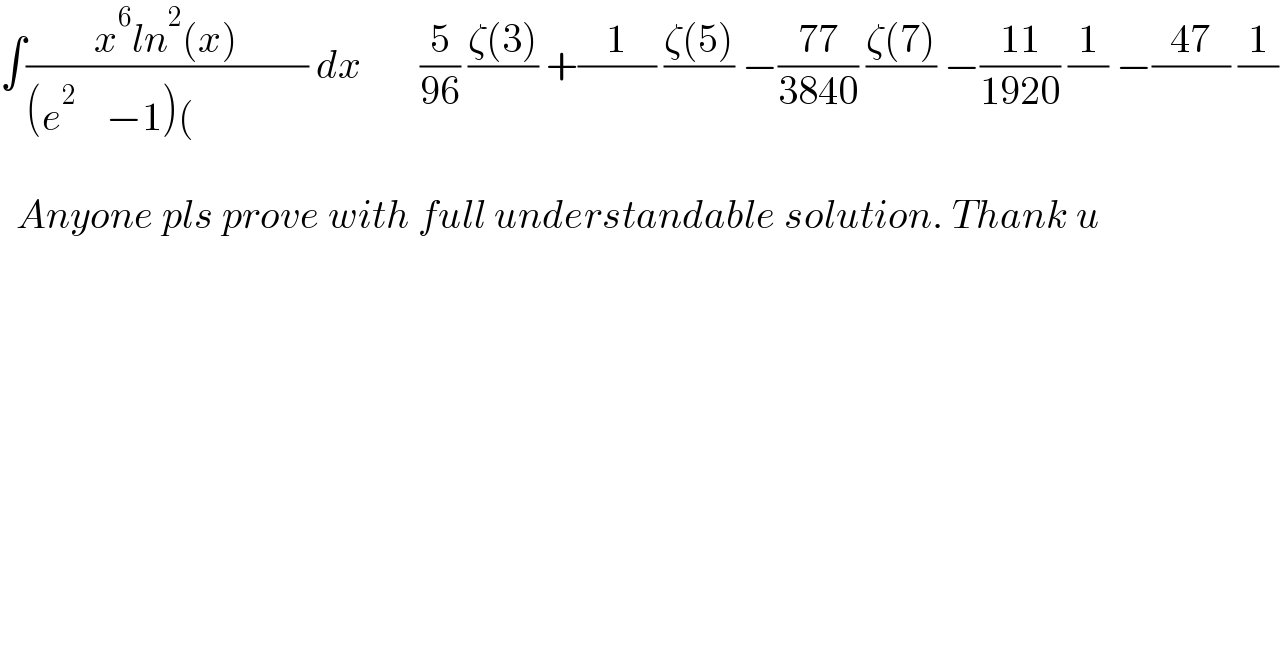
∫((x^6 ln^2 (x))/((e^(2 ) −1)( )) dx (5/(96)) ((ζ(3))/ ) +(1/ ) ((ζ(5))/ ) −((77)/(3840)) ((ζ(7))/ ) −((11)/(1920)) (1/ ) −((47)/ ) (1/ )
Anyone pls prove with full understandable solution. Thank u
0
ans
3
cmts
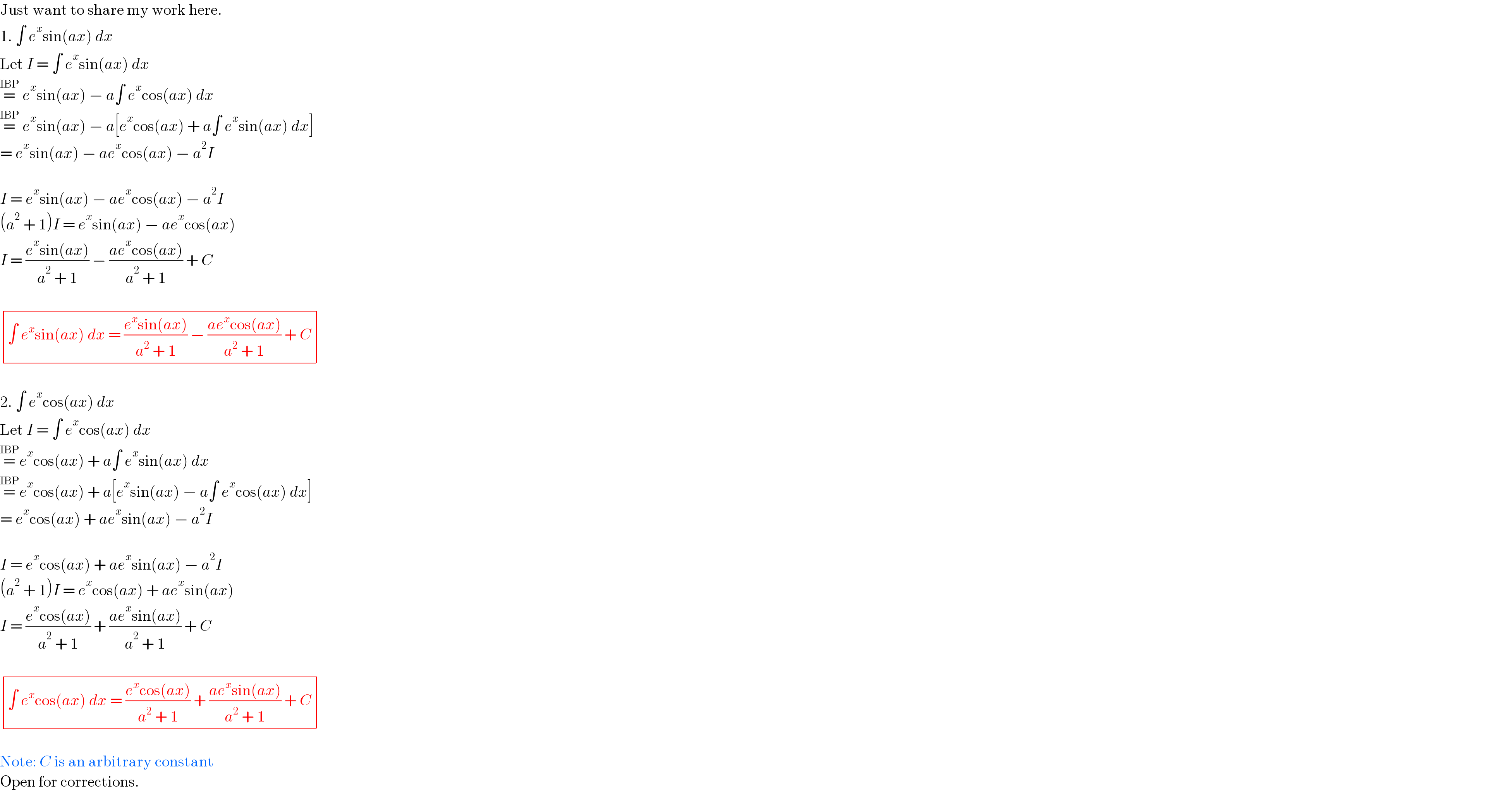
Just want to share my work here.
1. ∫ e^x sin(ax) dx
Let I = ∫ e^x sin(ax) dx
=^(IBP) e^x sin(ax) − a∫ e^x cos(ax) dx
=^(IBP) e^x sin(ax) − a[e^x cos(ax) + a∫ e^x sin(ax) dx]
= e^x sin(ax) − ae^x cos(ax) − a^2 I
I = e^x sin(ax) − ae^x cos(ax) − a^2 I
(a^2 + 1)I = e^x sin(ax) − ae^x cos(ax)
I = ((e^x sin(ax))/(a^2 + 1)) − ((ae^x cos(ax))/(a^2 + 1)) + C
determinant (((∫ e^x sin(ax) dx = ((e^x sin(ax))/(a^2 + 1)) − ((ae^x cos(ax))/(a^2 + 1)) + C)))
2. ∫ e^x cos(ax) dx
Let I = ∫ e^x cos(ax) dx
=^(IBP) e^x cos(ax) + a∫ e^x sin(ax) dx
=^(IBP) e^x cos(ax) + a[e^x sin(ax) − a∫ e^x cos(ax) dx]
= e^x cos(ax) + ae^x sin(ax) − a^2 I
I = e^x cos(ax) + ae^x sin(ax) − a^2 I
(a^2 + 1)I = e^x cos(ax) + ae^x sin(ax)
I = ((e^x cos(ax))/(a^2 + 1)) + ((ae^x sin(ax))/(a^2 + 1)) + C
determinant (((∫ e^x cos(ax) dx = ((e^x cos(ax))/(a^2 + 1)) + ((ae^x sin(ax))/(a^2 + 1)) + C)))
Note: C is an arbitrary constant
Open for corrections.
1
ans
1
cmts
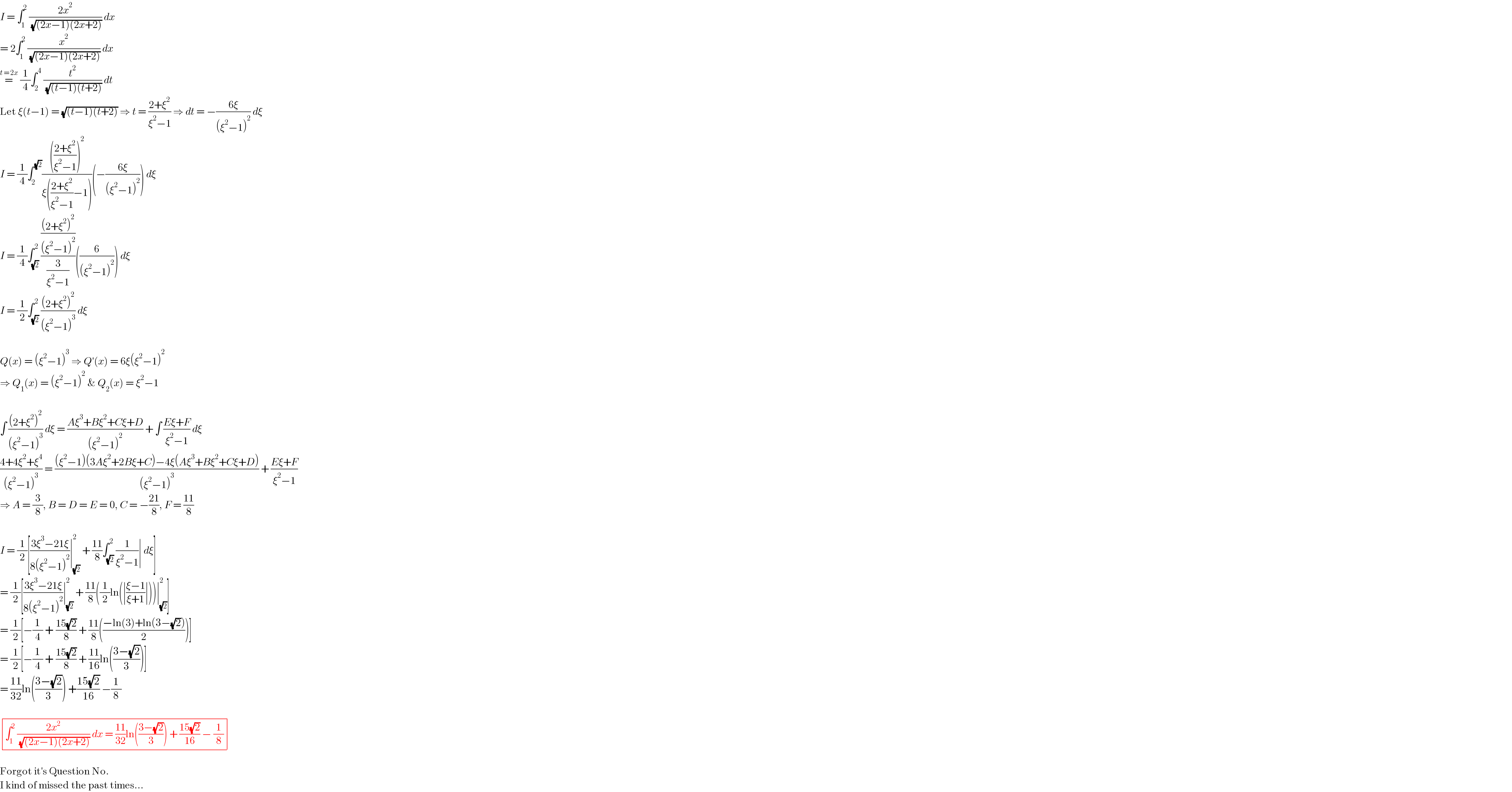
I = ∫_1 ^2 ((2x^2 )/( (√((2x−1)(2x+2))))) dx
= 2∫_1 ^2 (x^2 /( (√((2x−1)(2x+2))))) dx
=^(t = 2x) (1/4)∫_2 ^( 4) (t^2 /( (√((t−1)(t+2))))) dt
Let ξ(t−1) = (√((t−1)(t+2))) ⇒ t = ((2+ξ^2 )/(ξ^2 −1)) ⇒ dt = −((6ξ)/((ξ^2 −1)^2 )) dξ
I = (1/4)∫_2 ^( (√2)) (((((2+ξ^2 )/(ξ^2 −1)))^2 )/(ξ(((2+ξ^2 )/(ξ^2 −1))−1)))(−((6ξ)/((ξ^2 −1)^2 ))) dξ
I = (1/4)∫_(√2) ^( 2) ((((2+ξ^2 )^2 )/((ξ^2 −1)^2 ))/(3/(ξ^2 −1)))((6/((ξ^2 −1)^2 ))) dξ
I = (1/2)∫_(√2) ^( 2) (((2+ξ^2 )^2 )/((ξ^2 −1)^3 )) dξ
Q(x) = (ξ^2 −1)^3 ⇒ Q′(x) = 6ξ(ξ^2 −1)^2
⇒ Q_1 (x) = (ξ^2 −1)^2 & Q_2 (x) = ξ^2 −1
∫ (((2+ξ^2 )^2 )/((ξ^2 −1)^3 )) dξ = ((Aξ^3 +Bξ^2 +Cξ+D)/((ξ^2 −1)^2 )) + ∫ ((Eξ+F)/(ξ^2 −1)) dξ
((4+4ξ^2 +ξ^4 )/((ξ^2 −1)^3 )) = (((ξ^2 −1)(3Aξ^2 +2Bξ+C)−4ξ(Aξ^3 +Bξ^2 +Cξ+D))/((ξ^2 −1)^3 )) + ((Eξ+F)/(ξ^2 −1))
⇒ A = (3/8), B = D = E = 0, C = −((21)/8), F = ((11)/8)
I = (1/2)[((3ξ^3 −21ξ)/(8(ξ^2 −1)^2 ))∣_(√2) ^2 + ((11)/8)∫_(√2) ^( 2) (1/(ξ^2 −1))∣ dξ]
= (1/2)[((3ξ^3 −21ξ)/(8(ξ^2 −1)^2 ))∣_(√2) ^2 + ((11)/8)((1/2)ln(∣((ξ−1)/(ξ+1))∣))∣_(√2) ^2 ]
= (1/2)[−(1/4) + ((15(√2))/8) + ((11)/8)(((−ln(3)+ln(3−(√2)))/2))]
= (1/2)[−(1/4) + ((15(√2))/8) + ((11)/(16))ln(((3−(√2))/3))]
= ((11)/(32))ln(((3−(√2))/3)) +((15(√2))/(16)) −(1/8)
determinant (((∫_1 ^2 ((2x^2 )/( (√((2x−1)(2x+2))))) dx = ((11)/(32))ln(((3−(√2))/3)) + ((15(√2))/(16)) − (1/8))))
Forgot it′s Question No.
I kind of missed the past times...
0
ans
0
cmts
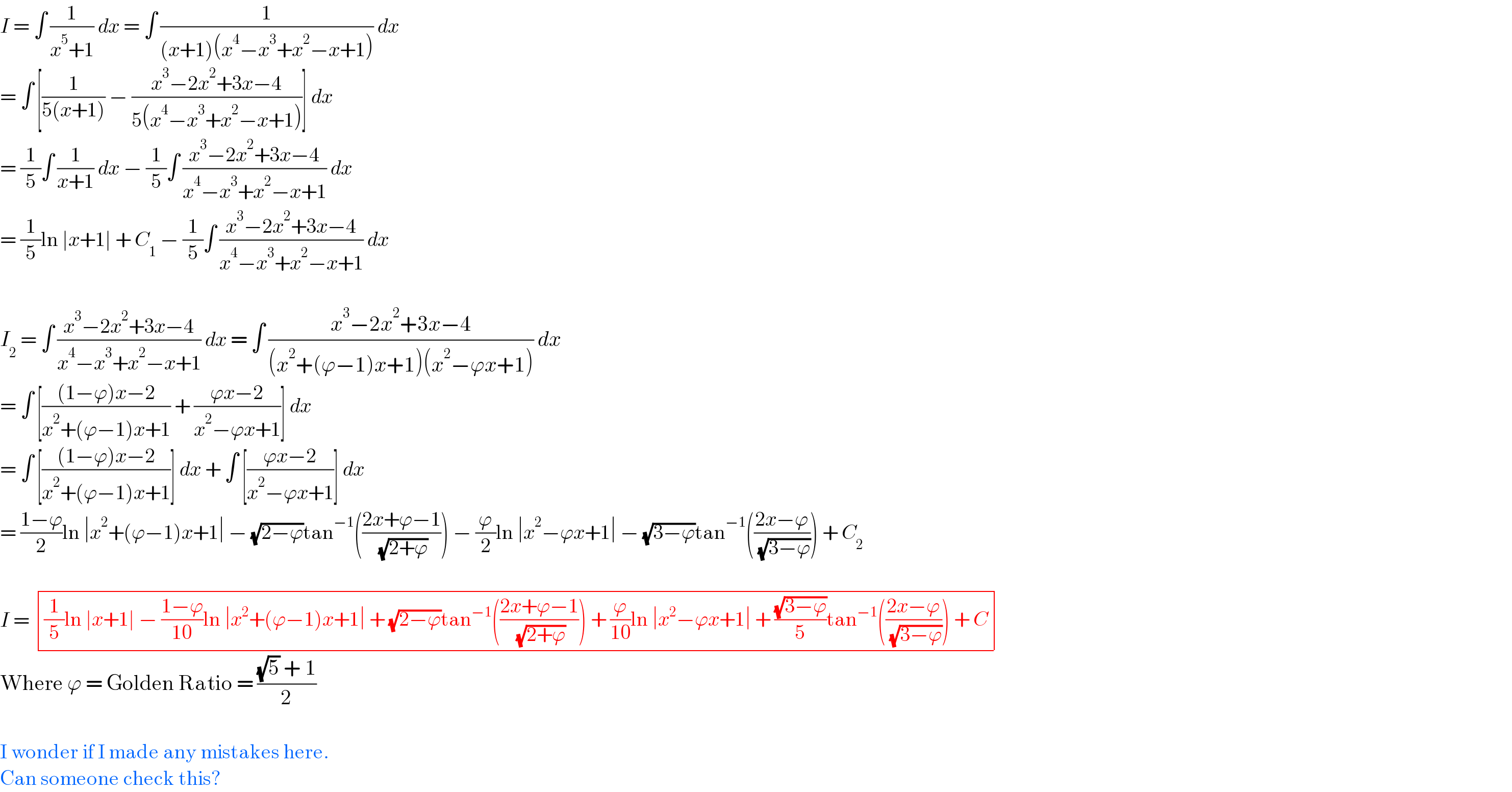
I = ∫ (1/(x^5 +1)) dx = ∫ (1/((x+1)(x^4 −x^3 +x^2 −x+1))) dx
= ∫ [(1/(5(x+1))) − ((x^3 −2x^2 +3x−4)/(5(x^4 −x^3 +x^2 −x+1)))] dx
= (1/5)∫ (1/(x+1)) dx − (1/5)∫ ((x^3 −2x^2 +3x−4)/(x^4 −x^3 +x^2 −x+1)) dx
= (1/5)ln ∣x+1∣ + C_1 − (1/5)∫ ((x^3 −2x^2 +3x−4)/(x^4 −x^3 +x^2 −x+1)) dx
I_2 = ∫ ((x^3 −2x^2 +3x−4)/(x^4 −x^3 +x^2 −x+1)) dx = ∫ ((x^3 −2x^2 +3x−4)/((x^2 +(ϕ−1)x+1)(x^2 −ϕx+1))) dx
= ∫ [(((1−ϕ)x−2)/(x^2 +(ϕ−1)x+1)) + ((ϕx−2)/(x^2 −ϕx+1))] dx
= ∫ [(((1−ϕ)x−2)/(x^2 +(ϕ−1)x+1))] dx + ∫ [((ϕx−2)/(x^2 −ϕx+1))] dx
= ((1−ϕ)/2)ln ∣x^2 +(ϕ−1)x+1∣ − (√(2−ϕ))tan^(−1) (((2x+ϕ−1)/( (√(2+ϕ))))) − (ϕ/2)ln ∣x^2 −ϕx+1∣ − (√(3−ϕ))tan^(−1) (((2x−ϕ)/( (√(3−ϕ))))) + C_2
I = determinant ((((1/5)ln ∣x+1∣ − ((1−ϕ)/(10))ln ∣x^2 +(ϕ−1)x+1∣ + (√(2−ϕ))tan^(−1) (((2x+ϕ−1)/( (√(2+ϕ))))) + (ϕ/(10))ln ∣x^2 −ϕx+1∣ + ((√(3−ϕ))/5)tan^(−1) (((2x−ϕ)/( (√(3−ϕ))))) + C)))
Where ϕ = Golden Ratio = (((√5) + 1)/2)
I wonder if I made any mistakes here.
Can someone check this?
0
ans
0
cmts
Question 227988

0
ans
1
cmts
Question 227871
1
ans
1
cmts
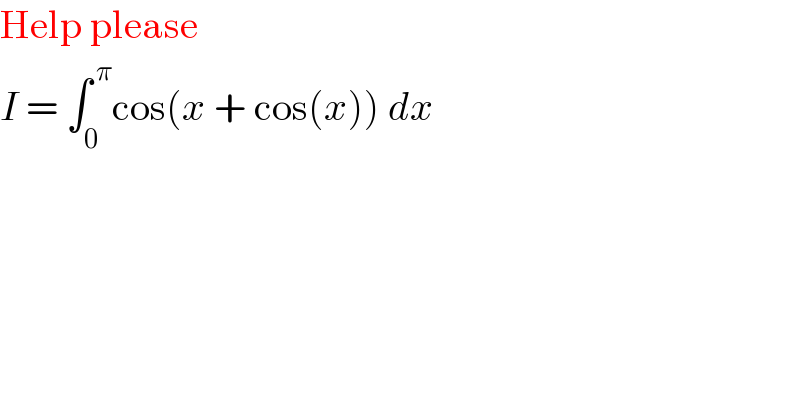
Help please
I = ∫_0 ^( π) cos(x + cos(x)) dx
3
ans
0
cmts
Question 227271
8
ans
0
cmts
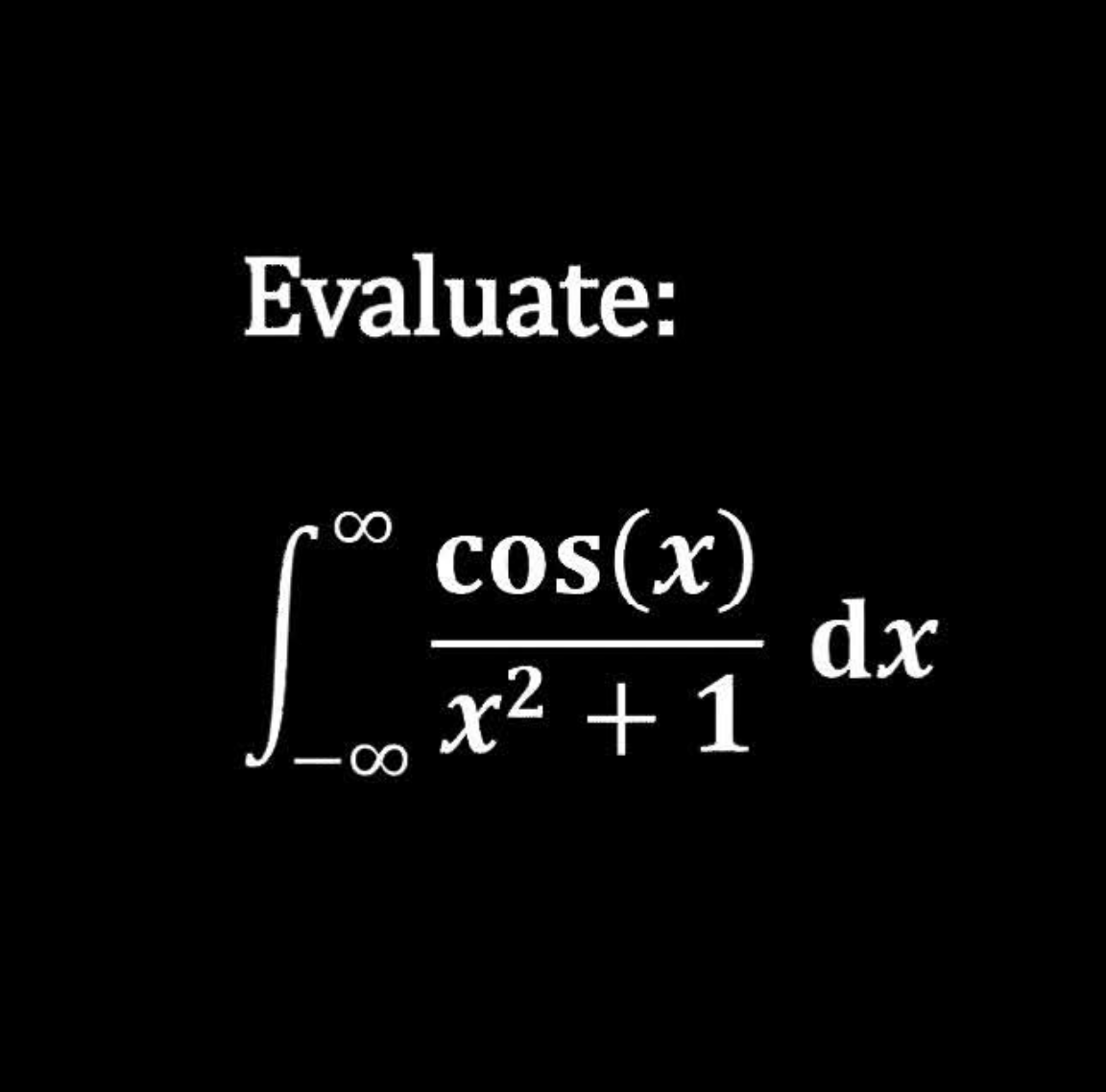
Question 227255
3
ans
0
cmts
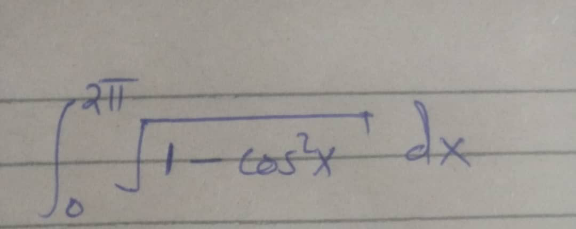
Question 227184
1
ans
0
cmts
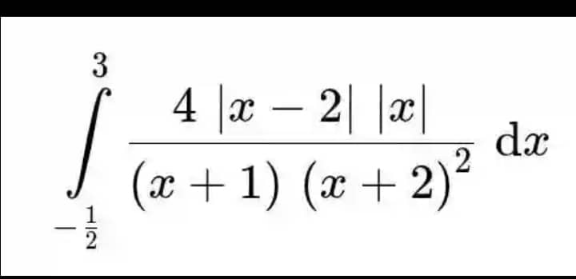
Question 227149
2
ans
0
cmts
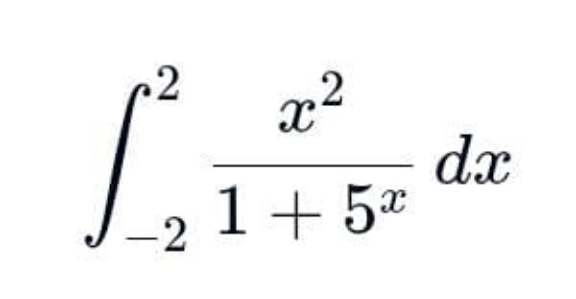
Question 227146
1
ans
0
cmts
Question 227128
1
ans
2
cmts
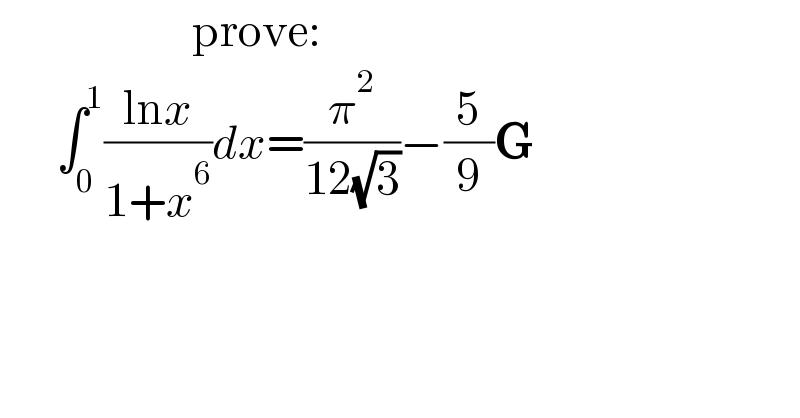
prove:
∫_0 ^1 ((lnx)/(1+x^6 ))dx=(π^2 /(12(√3)))−(5/9)G
1
ans
0
cmts
∫_0 ^1 ⌊log_2 (x−2^(⌊log_2 x⌋) )⌋dx

1
ans
0
cmts
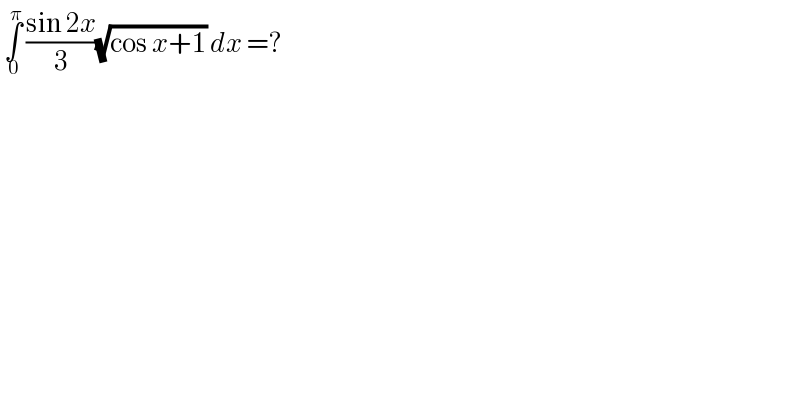
∫_0 ^π ((sin 2x)/3)(√(cos x+1)) dx =?
1
ans
0
cmts
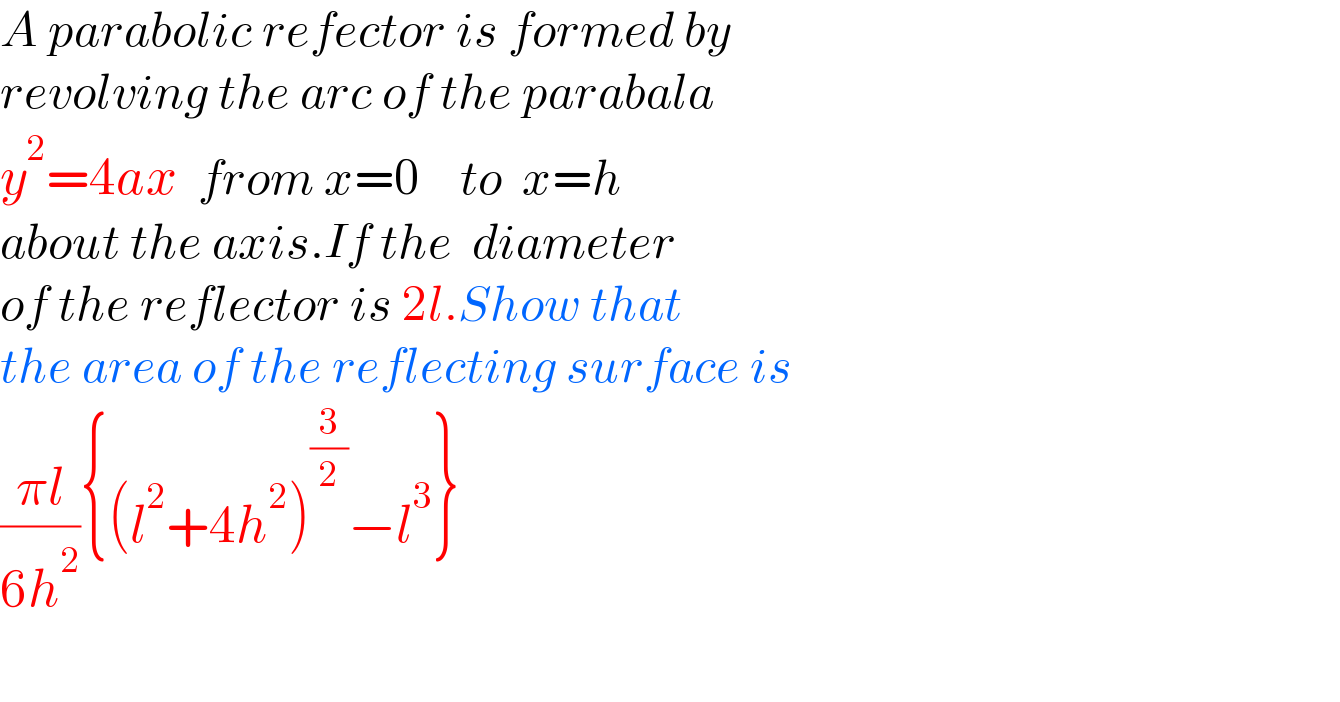
A parabolic refector is formed by
revolving the arc of the parabala
y^2 =4ax from x=0 to x=h
about the axis.If the diameter
of the reflector is 2l.Show that
the area of the reflecting surface is
((πl)/(6h^2 )){(l^2 +4h^2 )^(3/2) −l^3 }
3
ans
0
cmts
Question 226995
4
ans
0
cmts
Question 226994
1
ans
0
cmts
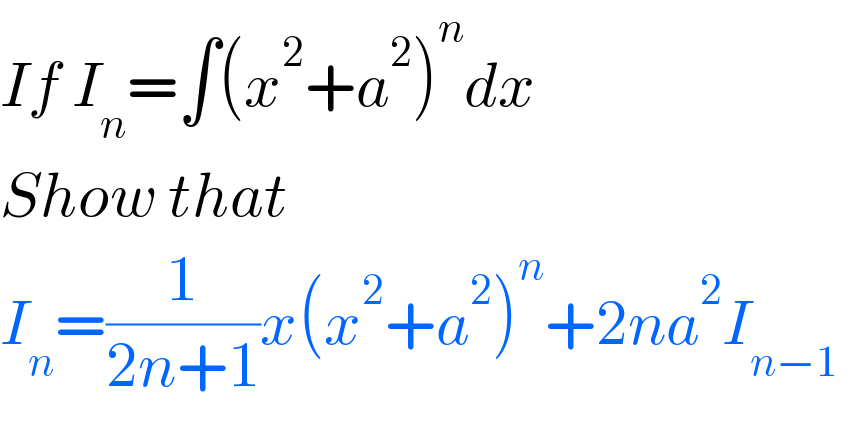
If I_n =∫(x^2 +a^2 )^n dx
Show that
I_n =(1/(2n+1))x(x^2 +a^2 )^n +2na^2 I_(n−1)
4
ans
0
cmts
Question 226952
1
ans
0
cmts
Evaluate
∫_0 ^∞ (dx/(1+x^2 ))

1
ans
0
cmts
Evaluate
∫((x^2 +2x−1)/(2x^3 +3x^2 −2x))dx

2
ans
0
cmts
∫_0 ^1 ((ln(1+x^2 ))/(1+x)) dx = ?

1
ans
0
cmts
By using concept of complex
number
show that
tan 5θ=((tan^5 θ−10tan^3 θ+5tan θ)/(5tan^4 θ−10tan^2 θ+1))

4
ans
0
cmts
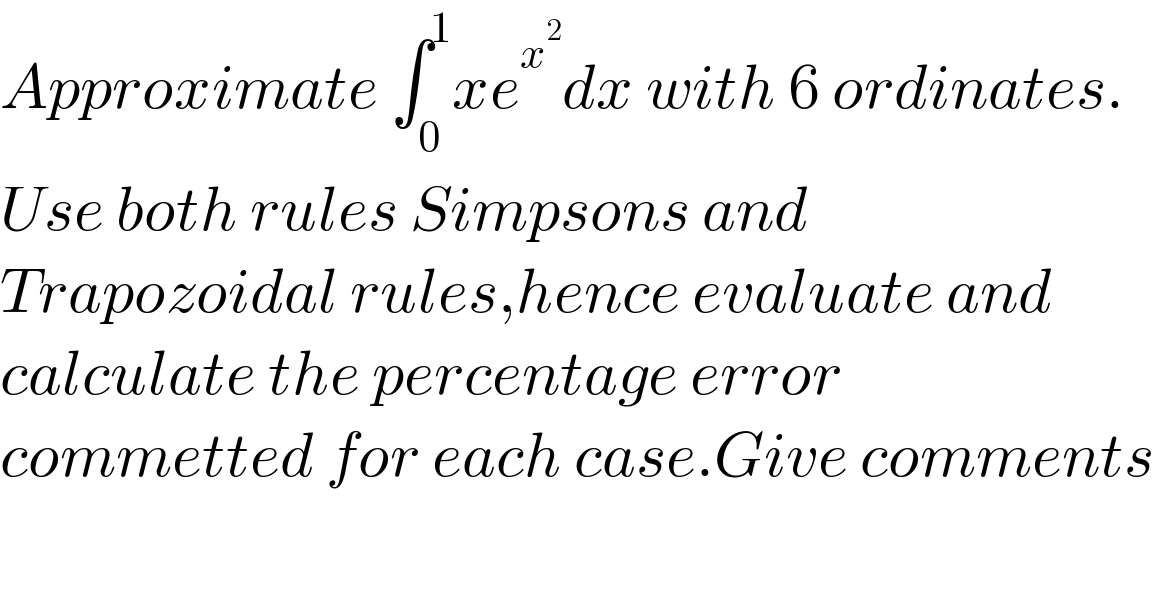
Approximate ∫_0 ^1 xe^x^2 dx with 6 ordinates.
Use both rules Simpsons and
Trapozoidal rules,hence evaluate and
calculate the percentage error
commetted for each case.Give comments
1
ans
0
cmts
Question 226668
4
ans
0
cmts
Question 226561
3
ans
0
cmts
Question 226554
1
ans
0
cmts
Question 226339
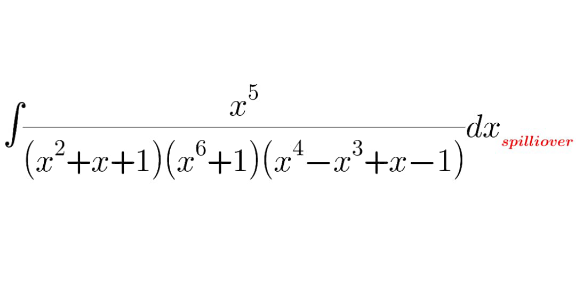
2
ans
0
cmts
Question 226292
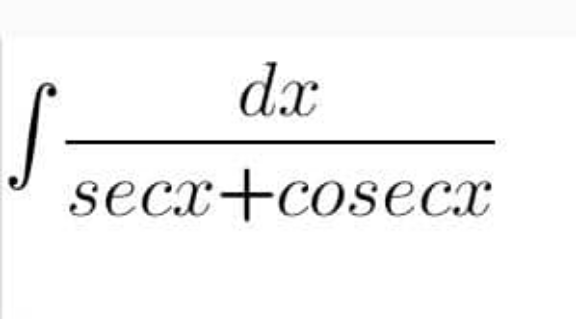
1
ans
0
cmts
Question 226290
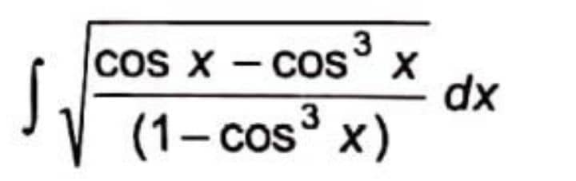
1
ans
0
cmts
Question 226178
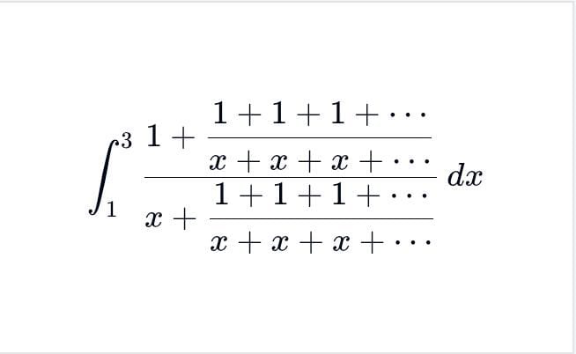
1
ans
0
cmts
Question 226148
1
ans
0
cmts
Question 226147
0
ans
0
cmts
Question 226113
1
ans
1
cmts
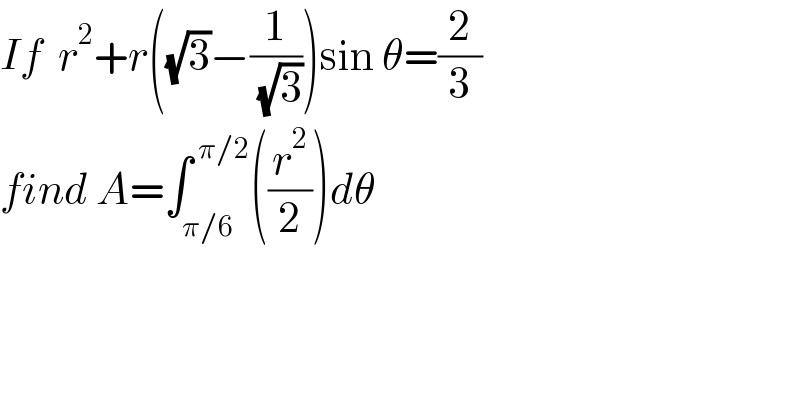
If r^2 +r((√3)−(1/( (√3))))sin θ=(2/3)
find A=∫_(π/6) ^( π/2) ((r^2 /2))dθ
2
ans
0
cmts
Question 225994
1
ans
25
cmts
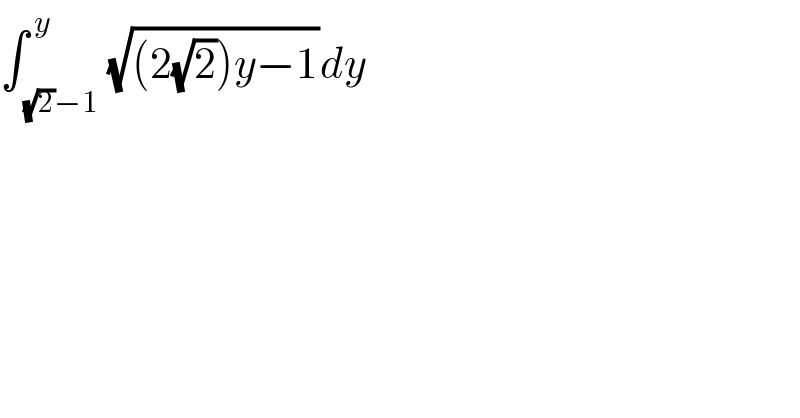
∫_( (√2)−1) ^( y) (√((2(√2))y−1))dy
2
ans
0
cmts
Question 225629
0
ans
0
cmts
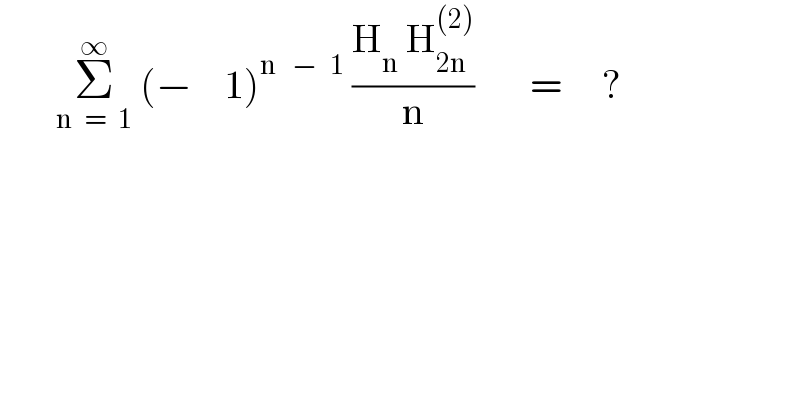
Σ_(n = 1) ^∞ (− 1)^(n − 1) ((H_n H_(2n) ^((2)) )/n) = ?
1
ans
0
cmts
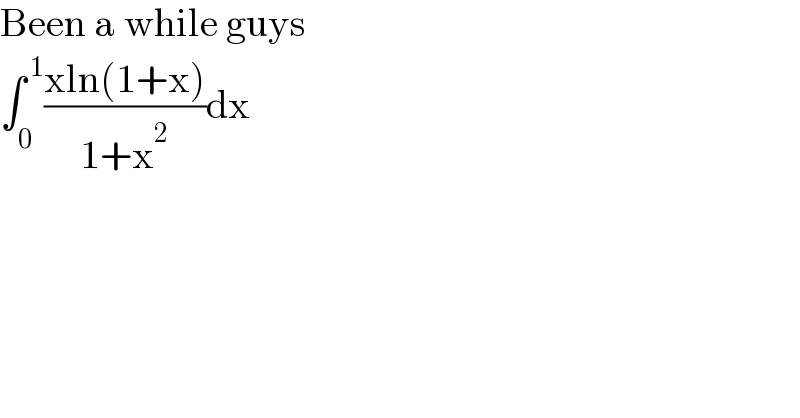
Been a while guys
∫_0 ^( 1) ((xln(1+x))/(1+x^2 ))dx
1
ans
0
cmts
∫_( 0) ^( 1) ((x ln(1 + x) Li_2 (x))/(1 + x^2 )) dx

0
ans
0
cmts
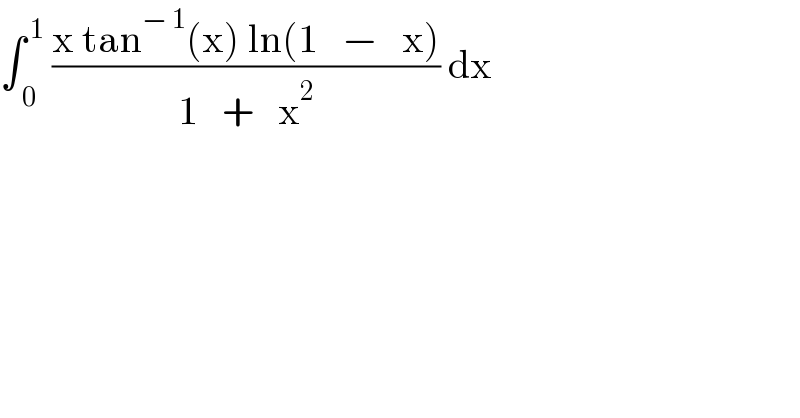
∫_( 0) ^( 1) ((x tan^(− 1) (x) ln(1 − x))/(1 + x^2 )) dx
0
ans
0
cmts
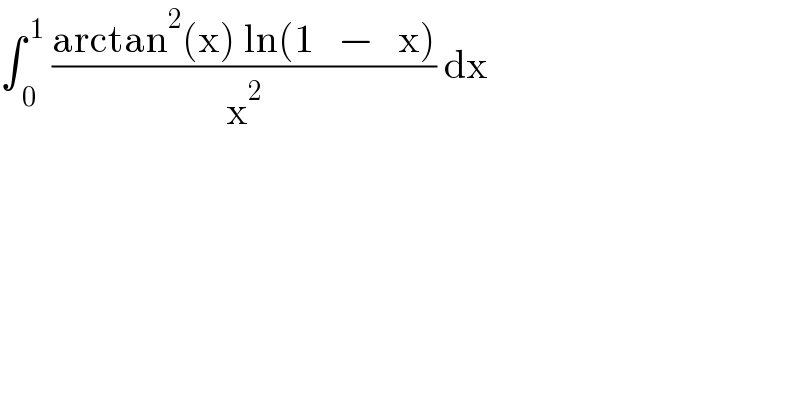
∫_( 0) ^( 1) ((arctan^2 (x) ln(1 − x))/x^2 ) dx
0
ans
0
cmts
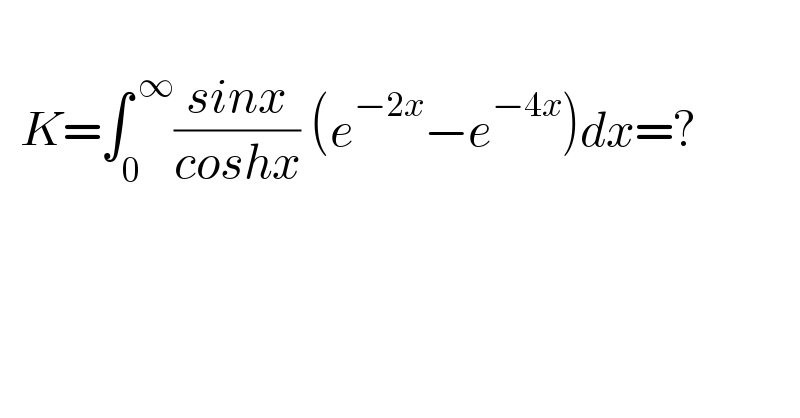
K=∫_0 ^( ∞) ((sinx)/(coshx)) (e^(−2x) −e^(−4x) )dx=?