1
ans
1
cmts
Question 228798
3
ans
2
cmts
Question 228455
1
ans
0
cmts
An insect moves from (0,0) to (6,3) by moving through lattice points ((x,y) integers) moving either one unit right or one unit up at each step. Let N be the number of paths in which the line segments joining (2,1),(2,2),(3,2) and (4,2) are avoided. find N.

1
ans
0
cmts
there are 32 students in a class. for
each competition in a sport event
in the school each class can send
a team with three students. if no
two students may be in the same
team for more than one time, in
how many different competitions
can this class participate?

0
ans
0
cmts
There are cards in 30 different colors, with 70 cards of each color. Initially, 70 cards are selected and laid out in a stack from top to bottom. One operation consists of: choosing an X from the bottom 20 cards, such that its color has not appeared in the top 50 cards; then choosing a Y from the top 50 cards, such that its color has appeared at least twice in the top 50 cards; removing X and placing it right above Y. Repeat this process until no more valid X can be chosen.
(1) Prove that the number of operations is finite.
(2) For all possible initial configurations and sequences of operations, find the maximum possible number of operations.

1
ans
0
cmts
Question #227151

1
ans
0
cmts
(m/n)

1
ans
0
cmts
Question #227098

0
ans
0
cmts
Question 226289

1
ans
0
cmts
Question 226044

1
ans
0
cmts
Question 224709

1
ans
0
cmts
Question 224641
1
ans
0
cmts
Question #224634

2
ans
2
cmts
Question #224623

0
ans
5
cmts
Question 224398
0
ans
7
cmts
If I have 10 people and I want to create
pairings, so that every person is matched
with every other person at least once, how
many unique pairings will there be in total?

1
ans
0
cmts
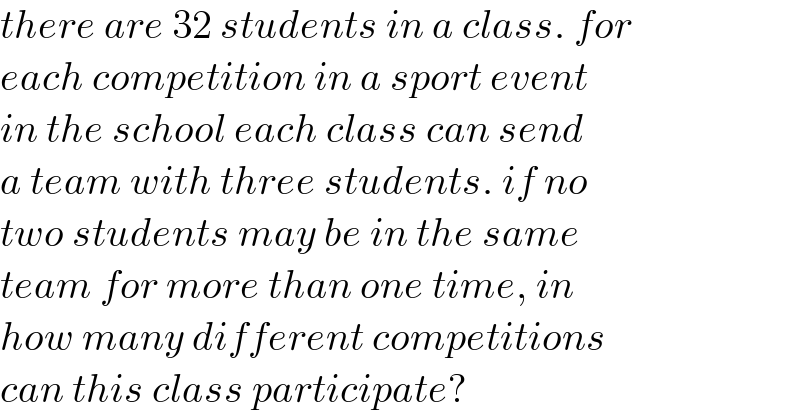
there are 32 students in a class. for
each competition in a sport event
in the school each class can send
a team with three students. if no
two students may be in the same
team for more than one time, in
how many different competitions
can this class participate?
1
ans
1
cmts
Question 222105
1
ans
1
cmts
Question 221661

1
ans
0
cmts
Question 220878
4
ans
0
cmts
Question 220877
3
ans
0
cmts
Question 220876
1
ans
2
cmts
Question 220874
1
ans
0
cmts
Question 220873

1
ans
0
cmts
Question 220872
1
ans
0
cmts
Question 220744
1
ans
0
cmts
Question 220743
1
ans
0
cmts
Question 220741
1
ans
0
cmts
Question 220740
1
ans
0
cmts
Question 220739
1
ans
0
cmts
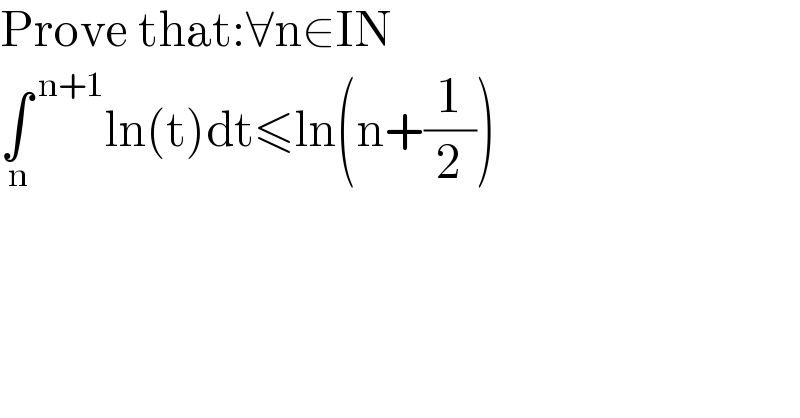
Prove that:∀n∈IN
∫^( n+1) _( n) ln(t)dt≤ln(n+(1/2))
2
ans
2
cmts
Question 219527
2
ans
0
cmts
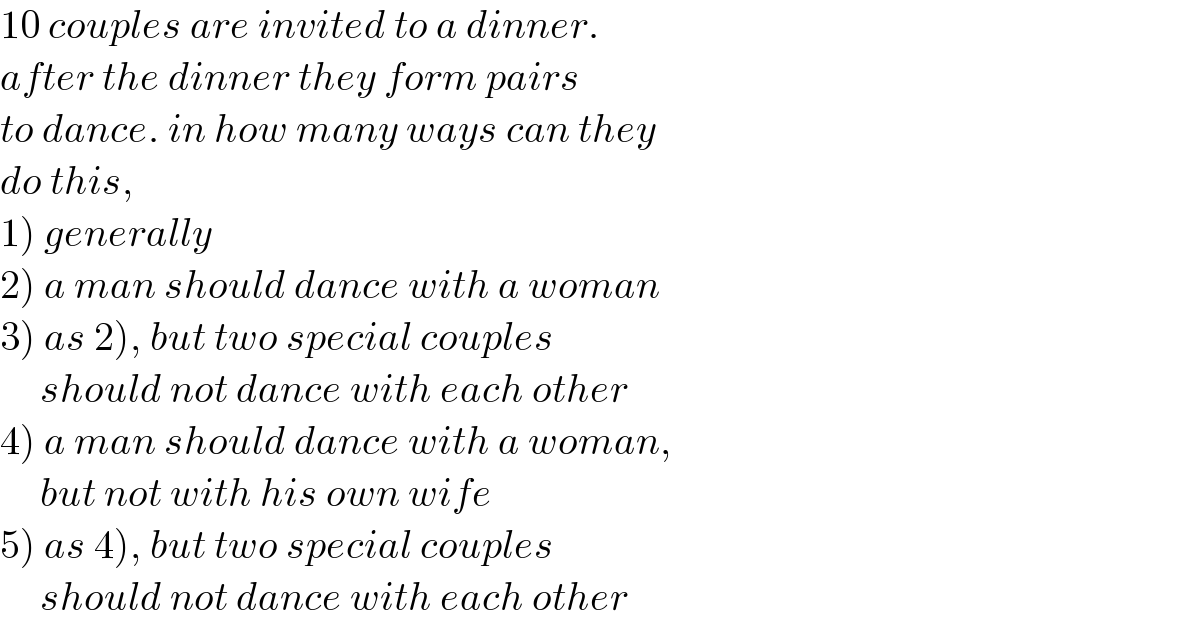
10 couples are invited to a dinner.
after the dinner they form pairs
to dance. in how many ways can they
do this,
1) generally
2) a man should dance with a woman
3) as 2), but two special couples
should not dance with each other
4) a man should dance with a woman,
but not with his own wife
5) as 4), but two special couples
should not dance with each other
3
ans
0
cmts
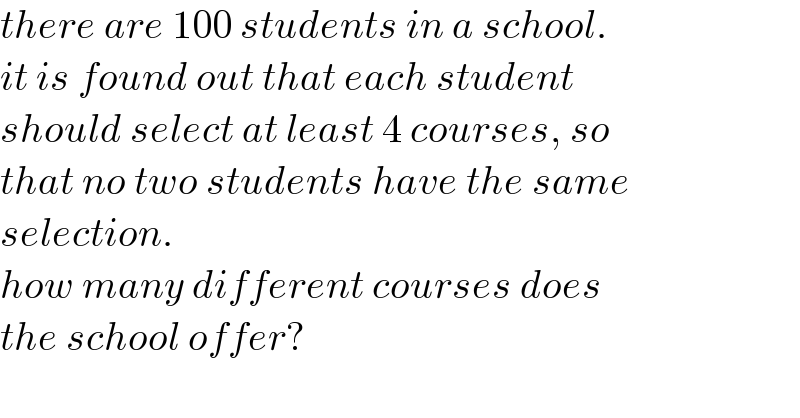
there are 100 students in a school.
it is found out that each student
should select at least 4 courses, so
that no two students have the same
selection.
how many different courses does
the school offer?
2
ans
1
cmts
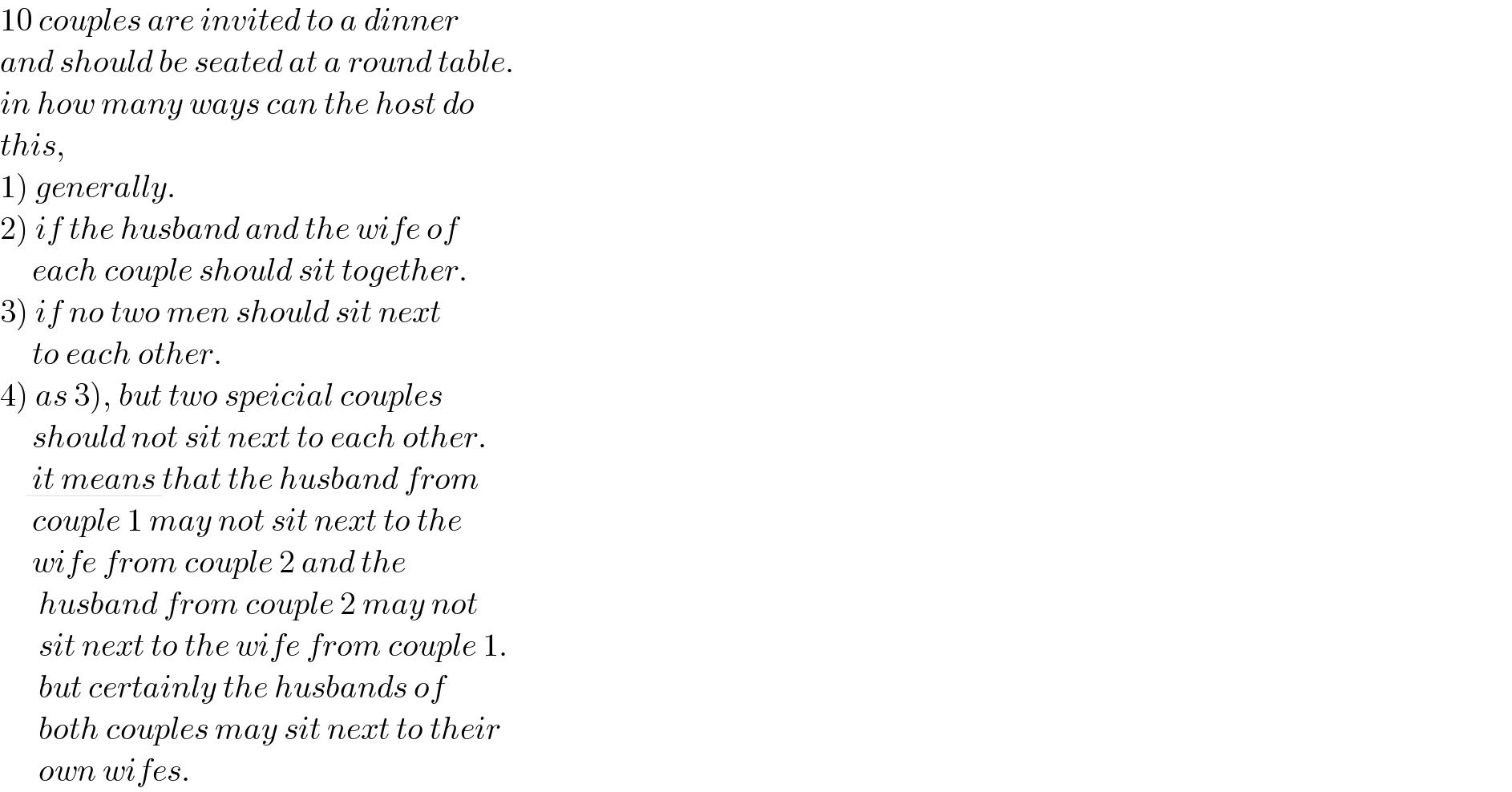
10 couples are invited to a dinner
and should be seated at a round table.
in how many ways can the host do
this,
1) generally.
2) if the husband and the wife of
each couple should sit together.
3) if no two men should sit next
to each other.
4) as 3), but two speicial couples
should not sit next to each other.
it means that the husband from
couple 1 may not sit next to the
wife from couple 2 and the
husband from couple 2 may not
sit next to the wife from couple 1.
but certainly the husbands of
both couples may sit next to their
own wifes.
0
ans
0
cmts
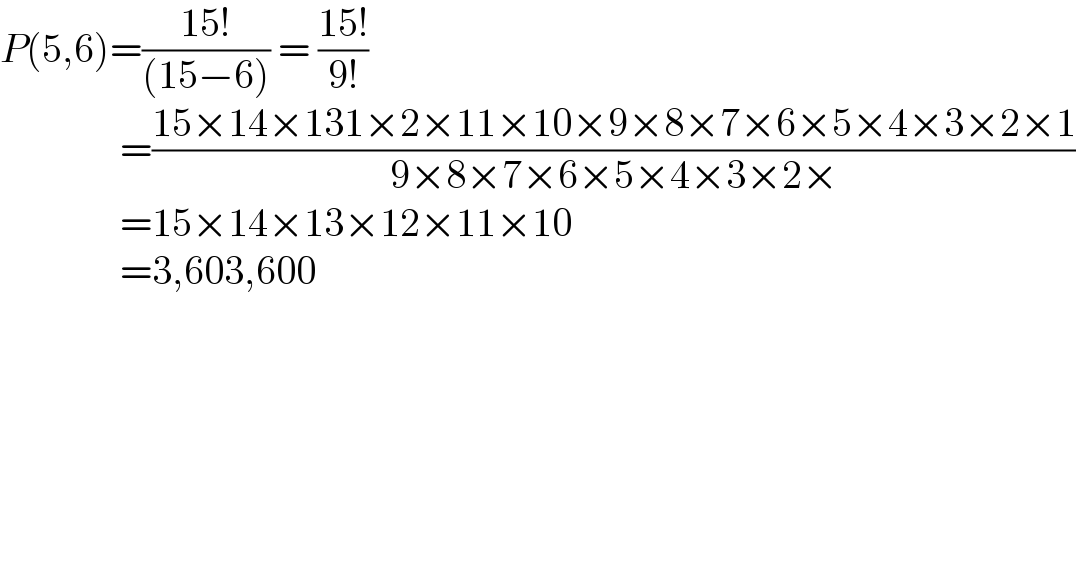
P(5,6)=((15!)/((15−6))) = ((15!)/(9!))
=((15×14×131×2×11×10×9×8×7×6×5×4×3×2×1)/(9×8×7×6×5×4×3×2×))
=15×14×13×12×11×10
=3,603,600
2
ans
0
cmts
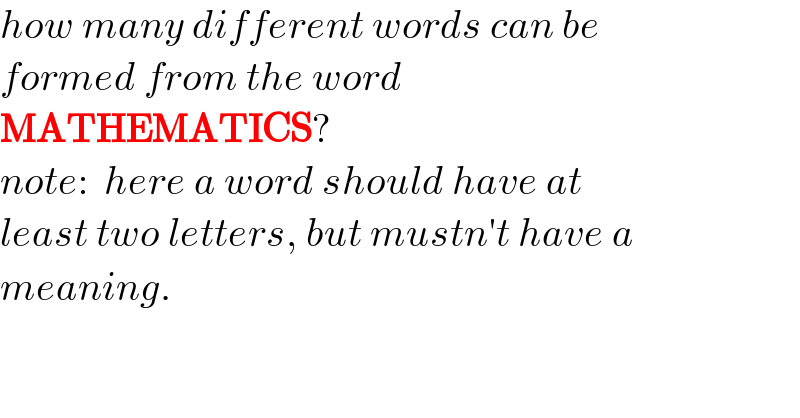
how many different words can be
formed from the word
MATHEMATICS?
note: here a word should have at
least two letters, but mustn′t have a
meaning.
3
ans
0
cmts
Question 217402
0
ans
0
cmts
Question 214923
4
ans
0
cmts
Question 213796
4
ans
4
cmts
in how many ways can a teacher
divide his 10 studens into 4 groups
such that each group has at least 2
students?

1
ans
0
cmts
Question 210290
2
ans
2
cmts
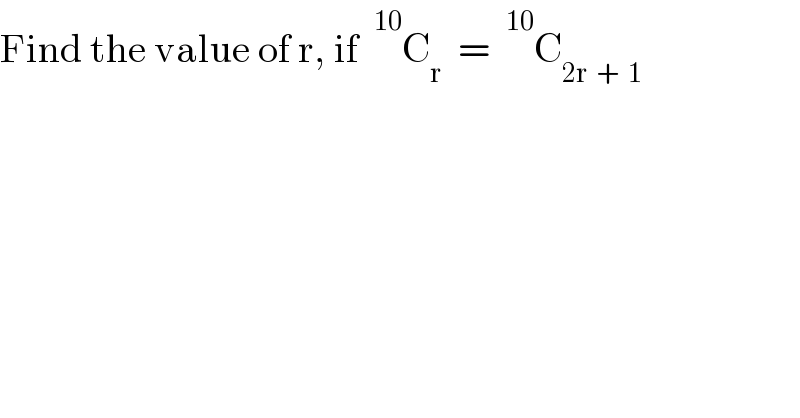
Find the value of r, if ^(10) C_r = ^(10) C_(2r + 1)
2
ans
0
cmts
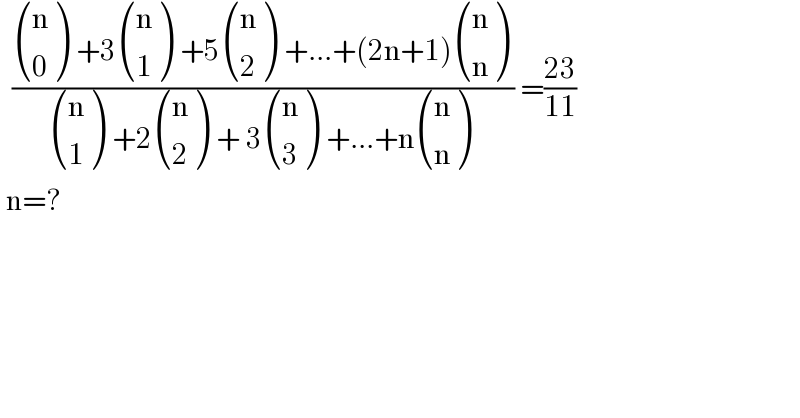
(( ((n),(0) ) +3 ((n),(1) ) +5 ((n),(2) ) +...+(2n+1) ((n),(n) ))/( ((n),(1) ) +2 ((n),(2) ) + 3 ((n),(3) ) +...+n ((n),(n) ))) =((23)/(11))
n=?
1
ans
0
cmts
Question 208263
1
ans
0
cmts
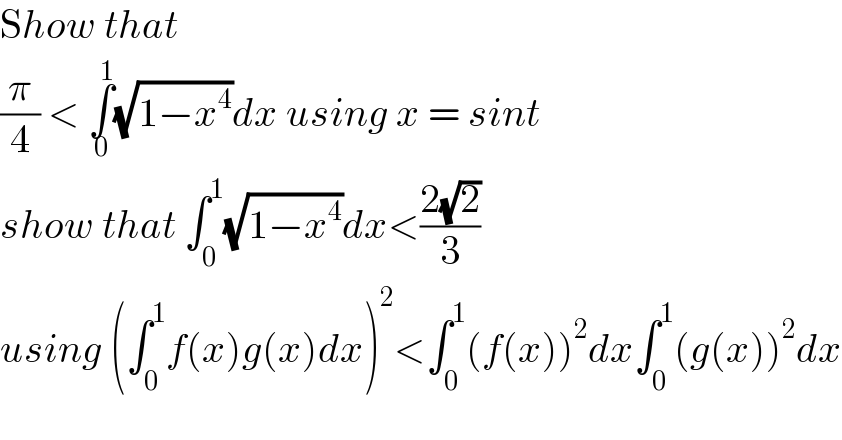
Show that
(π/4) < ∫_0 ^1 (√(1−x^4 ))dx using x = sint
show that ∫_0 ^1 (√(1−x^4 ))dx<((2(√2))/3)
using (∫_0 ^1 f(x)g(x)dx)^2 <∫_0 ^1 (f(x))^2 dx∫_0 ^1 (g(x))^2 dx
0
ans
0
cmts
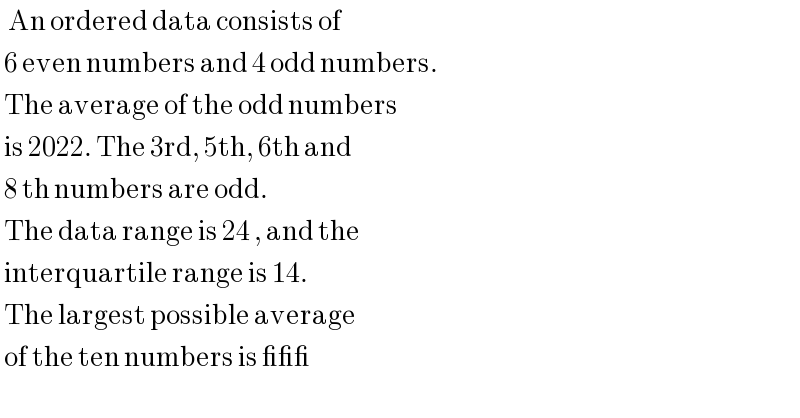
An ordered data consists of
6 even numbers and 4 odd numbers.
The average of the odd numbers
is 2022. The 3rd, 5th, 6th and
8 th numbers are odd.
The data range is 24 , and the
interquartile range is 14.
The largest possible average
of the ten numbers is ___
2
ans
0
cmts
Question 207179
0
ans
1
cmts
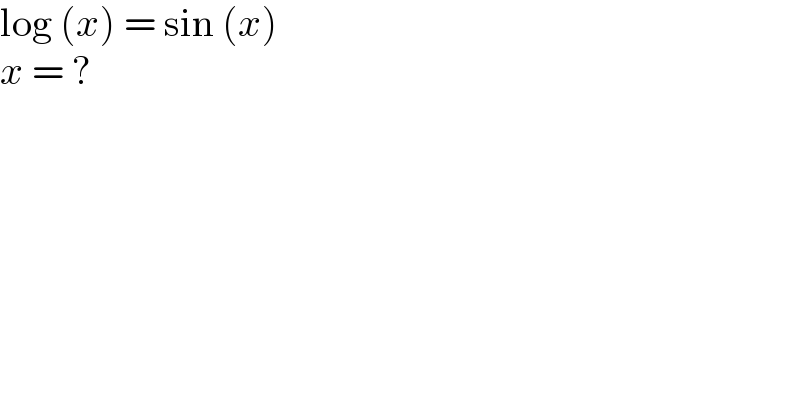
log (x) = sin (x)
x = ?
3
ans
6
cmts
Question #206681