2
ans
4
cmts
Question 227687
0
ans
3
cmts
Hello, friends rm,
in fact, just a day old here.
I need
p into MS-Word
H.C.V = (((m_w + m_e ) c_w (t_2 − t_1 ))/m_f ).
= (((2.5 + 0.39) 4.2 × 2.6)/(0.001)) kJ/kg
= (((2.89 ) × (4.2 × 2.6))/(0.001)) kJ/kg
= ((31.5588)/(0.001)) kJ/kg
= 31 558.8 kJ/kg
How do I transfer this typed formula and
calculation into microsoft word format?
Thanks!
0
ans
0
cmts
Question 206171
0
ans
1
cmts
Question 206168
0
ans
0
cmts
Question 200129

0
ans
0
cmts
Question 194194
0
ans
2
cmts
A wolf weighs 40 kg, how many kilo calories does it need to maintain its body temperature?
0
ans
0
cmts
Question 178587
0
ans
0
cmts
Question 175652
0
ans
2
cmts
Question 166067
0
ans
1
cmts
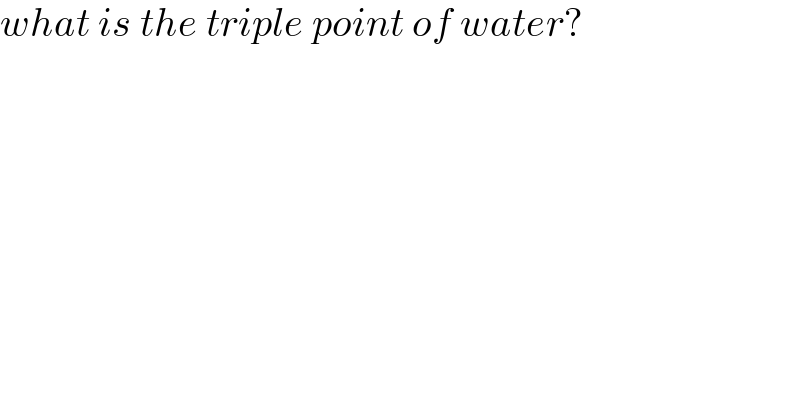
what is the triple point of water?
1
ans
1
cmts
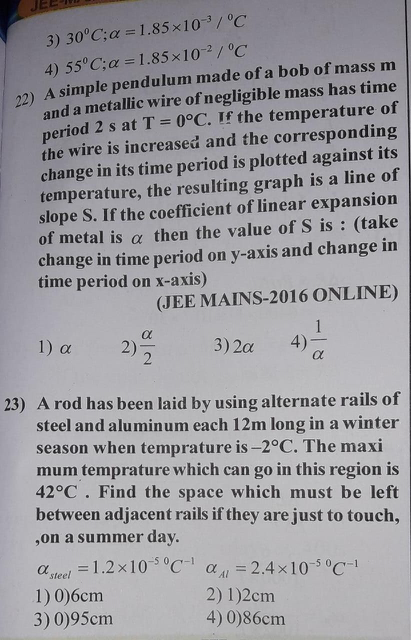
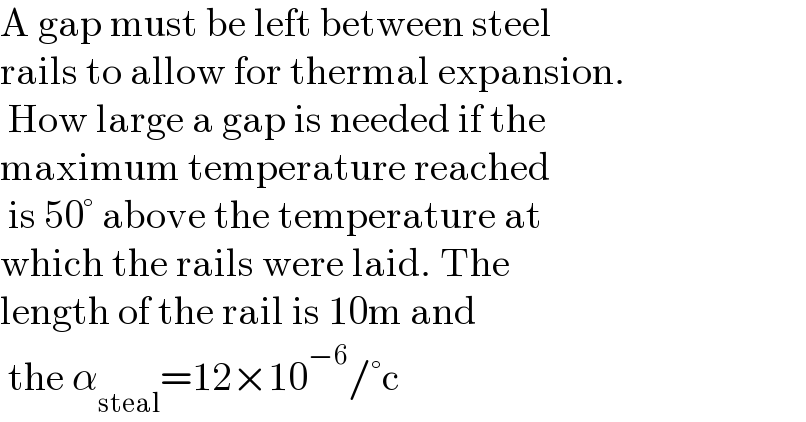
A gap must be left between steel
rails to allow for thermal expansion.
How large a gap is needed if the
maximum temperature reached
is 50° above the temperature at
which the rails were laid. The
length of the rail is 10m and
the α_(steal) =12×10^(−6) /°c
0
ans
3
cmts
Question 137317
0
ans
1
cmts
Question 136487
0
ans
0
cmts
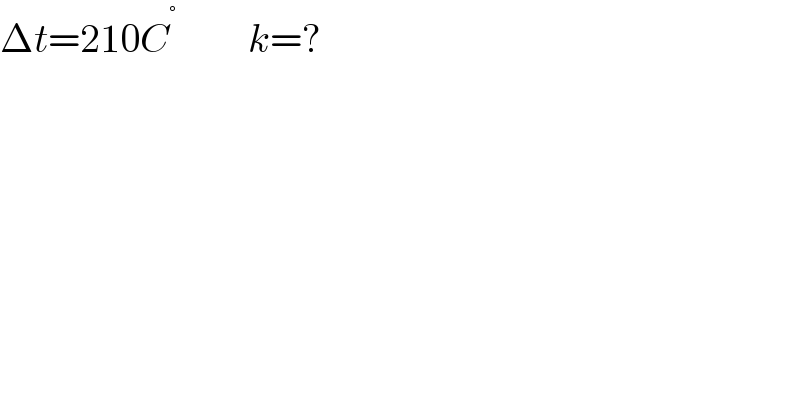
Δt=210C^° k=?
0
ans
0
cmts
Question 127423
0
ans
0
cmts
Question 127336
0
ans
0
cmts
Question 124414
1
ans
1
cmts
Question 119452
0
ans
0
cmts
Question 111388
0
ans
0
cmts
Question 110550
0
ans
0
cmts
Question 103484
0
ans
1
cmts
What will be the state of a system(isolated)when its entropy tends
to zero or zero?
Time get stopped??
or another things may happen
I am thinking about this
1
ans
0
cmts
Question 94922
0
ans
0
cmts
Question #90073

0
ans
0
cmts
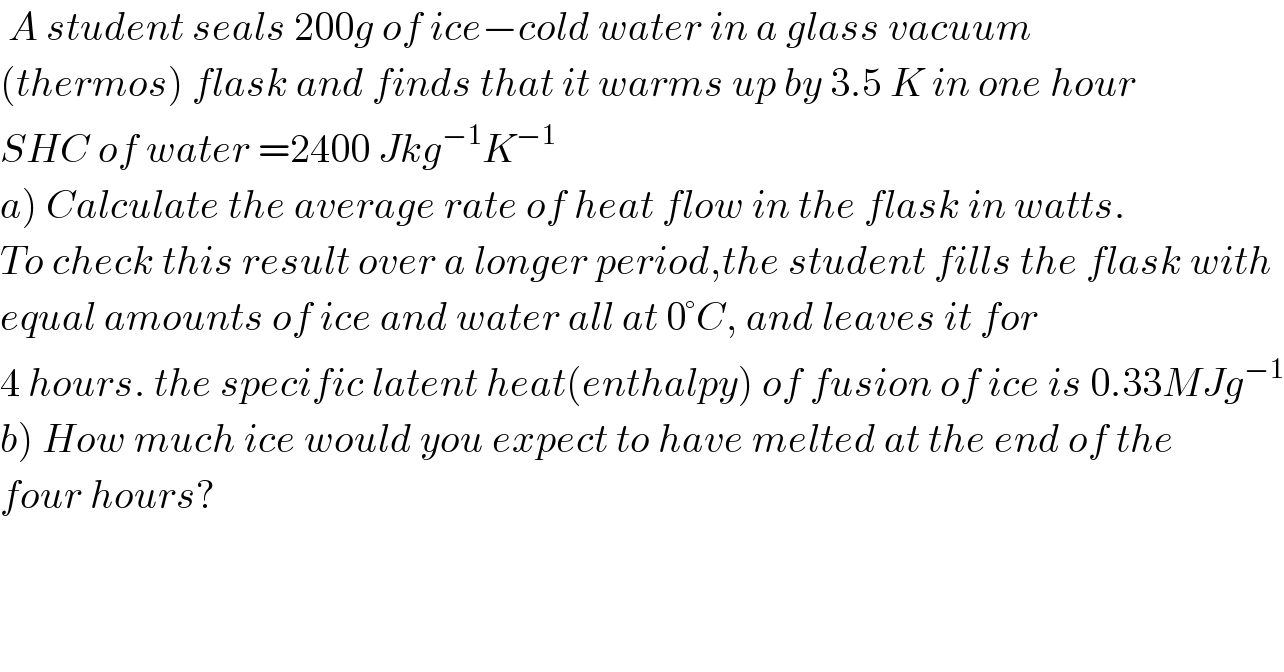
A student seals 200g of ice−cold water in a glass vacuum
(thermos) flask and finds that it warms up by 3.5 K in one hour
SHC of water =2400 Jkg^(−1) K^(−1)
a) Calculate the average rate of heat flow in the flask in watts.
To check this result over a longer period,the student fills the flask with
equal amounts of ice and water all at 0°C, and leaves it for
4 hours. the specific latent heat(enthalpy) of fusion of ice is 0.33MJg^(−1)
b) How much ice would you expect to have melted at the end of the
four hours?
0
ans
0
cmts
Question 75204
1
ans
0
cmts
Question 75203
1
ans
0
cmts
Question 75166
0
ans
1
cmts
Question 74359
0
ans
6
cmts
Question 74358
0
ans
1
cmts
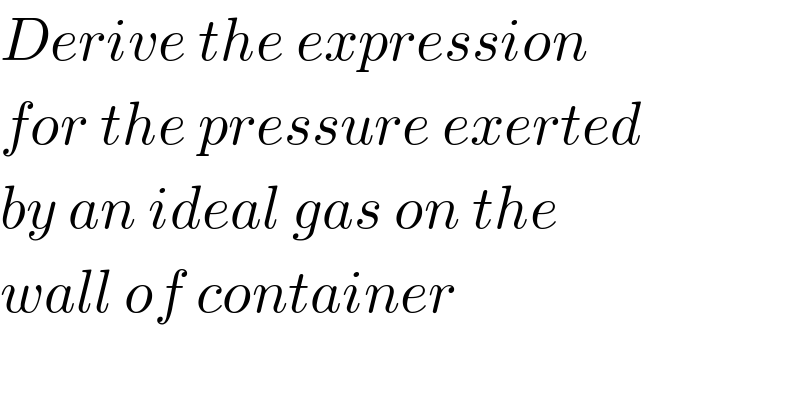
Derive the expression
for the pressure exerted
by an ideal gas on the
wall of container
0
ans
0
cmts
Question 71640
0
ans
4
cmts
Question 70620
0
ans
0
cmts
Question 59346
0
ans
3
cmts
Question 58380
0
ans
0
cmts
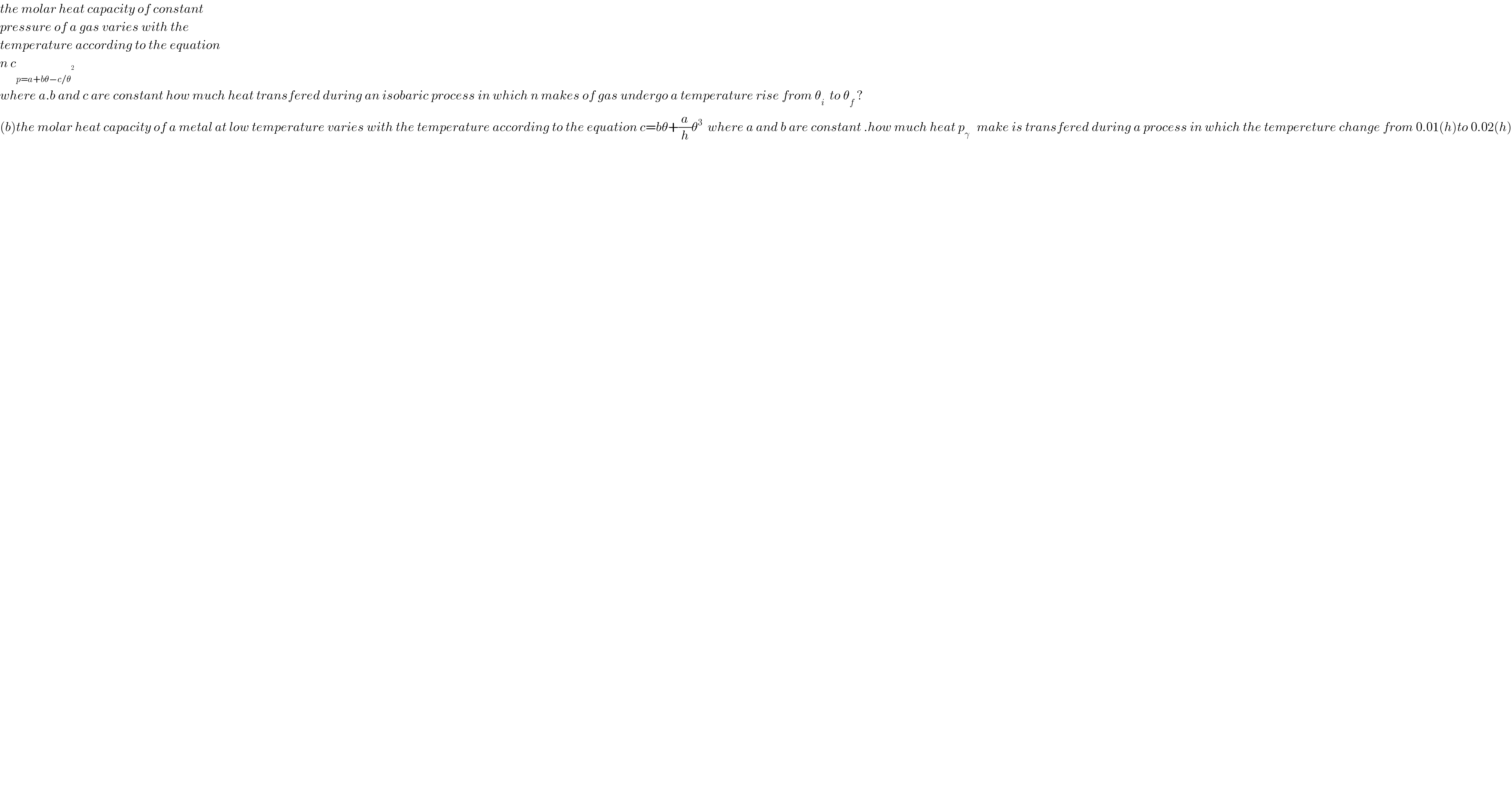
the molar heat capacity of constant
pressure of a gas varies with the
temperature according to the equation
n c_(p=a+bθ−c/θ^(2 _ ) )
where a.b and c are constant how much heat transfered during an isobaric process in which n makes of gas undergo a temperature rise from θ_i to θ_f ?
(b)the molar heat capacity of a metal at low temperature varies with the temperature according to the equation c=bθ+(a/h)θ^3 where a and b are constant .how much heat p_(γ ) make is transfered during a process in which the tempereture change from 0.01(h)to 0.02(h)
0
ans
1
cmts
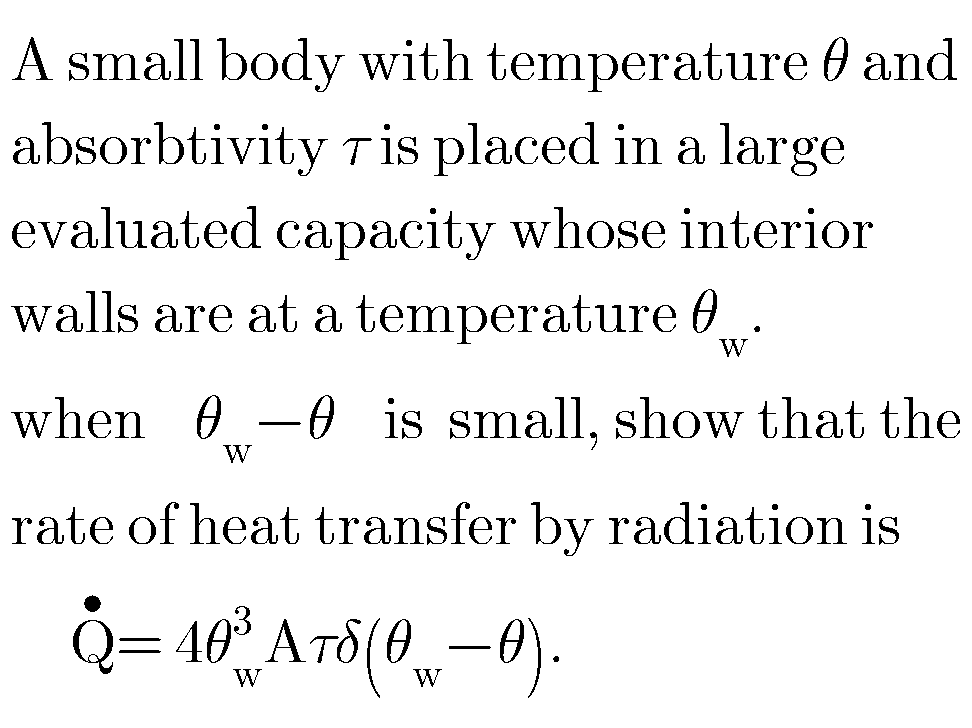
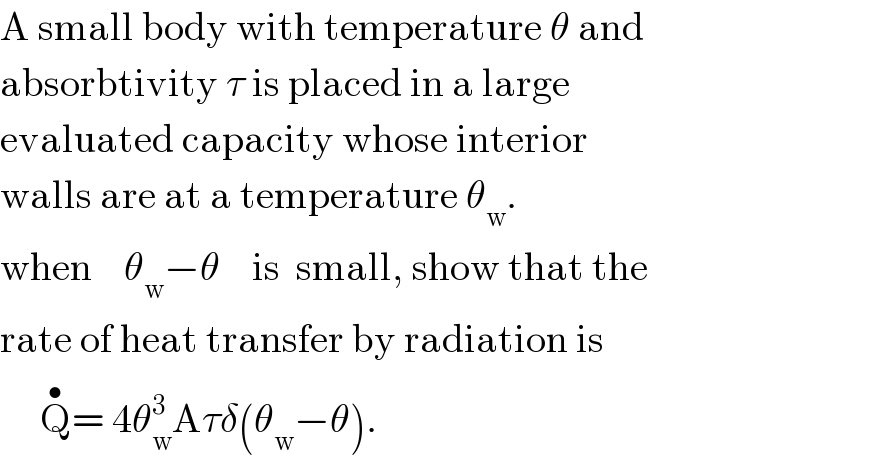
A small body with temperature θ and
absorbtivity τ is placed in a large
evaluated capacity whose interior
walls are at a temperature θ_w .
when θ_w −θ is small, show that the
rate of heat transfer by radiation is
Q^• = 4θ_w ^3 Aτδ(θ_w −θ).
1
ans
1
cmts
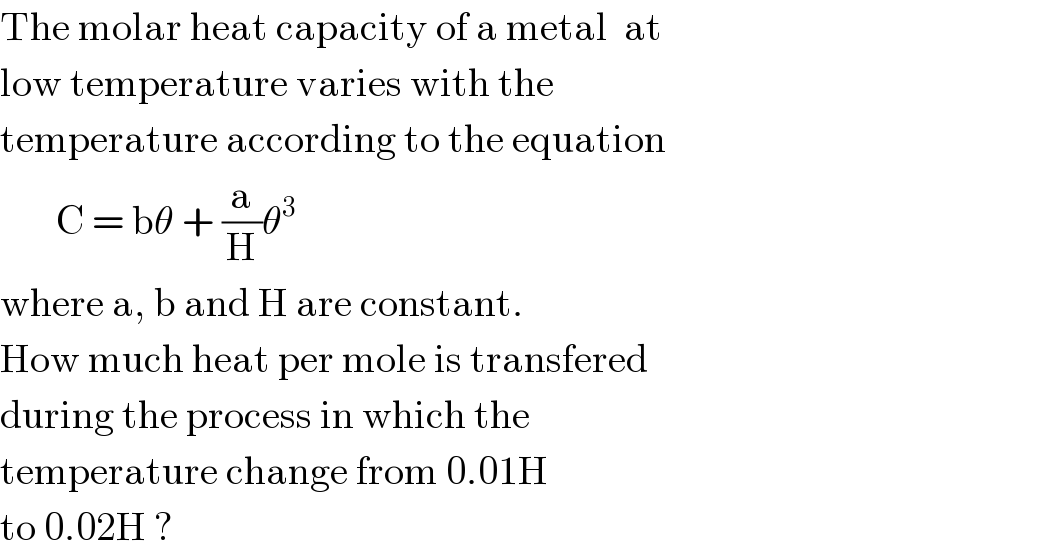
The molar heat capacity of a metal at
low temperature varies with the
temperature according to the equation
C = bθ + (a/H)θ^3
where a, b and H are constant.
How much heat per mole is transfered
during the process in which the
temperature change from 0.01H
to 0.02H ?
1
ans
0
cmts
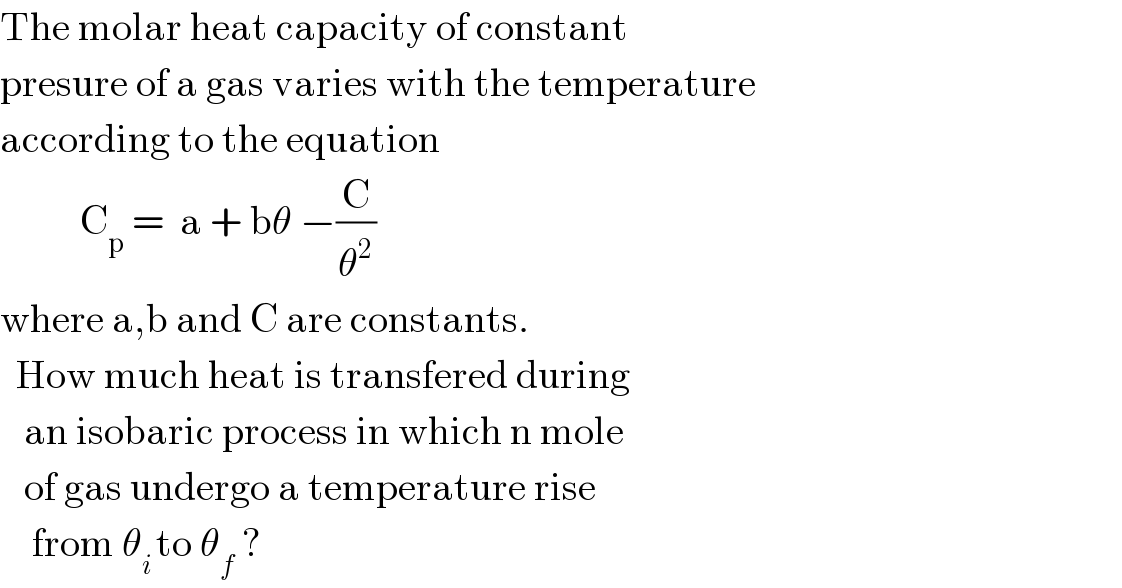
The molar heat capacity of constant
presure of a gas varies with the temperature
according to the equation
C_p = a + bθ −(C/θ^2 )
where a,b and C are constants.
How much heat is transfered during
an isobaric process in which n mole
of gas undergo a temperature rise
from θ_(i ) to θ_f ?
2
ans
0
cmts
Question 54584
1
ans
2
cmts
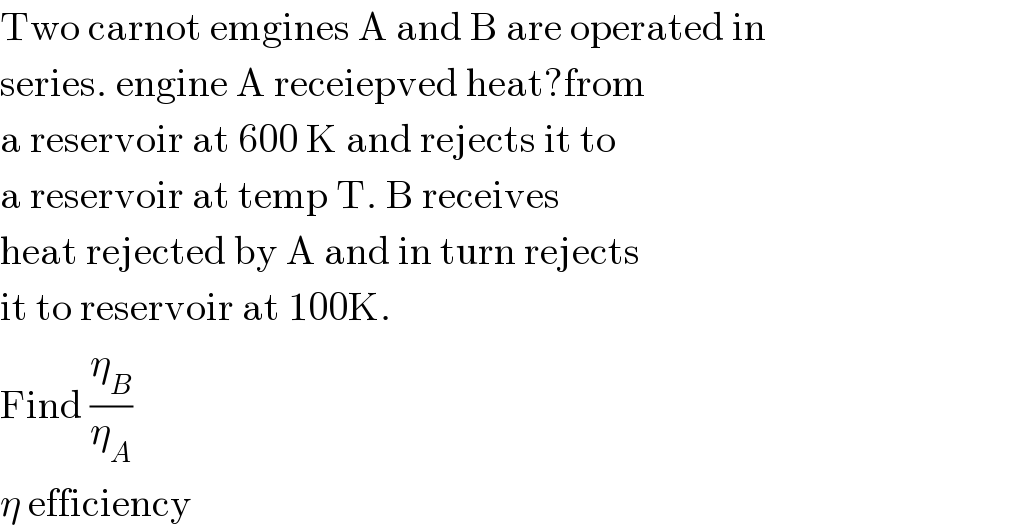
Two carnot emgines A and B are operated in
series. engine A receiepved heat?from
a reservoir at 600 K and rejects it to
a reservoir at temp T. B receives
heat rejected by A and in turn rejects
it to reservoir at 100K.
Find (η_B /η_A )
η efficiency
1
ans
0
cmts
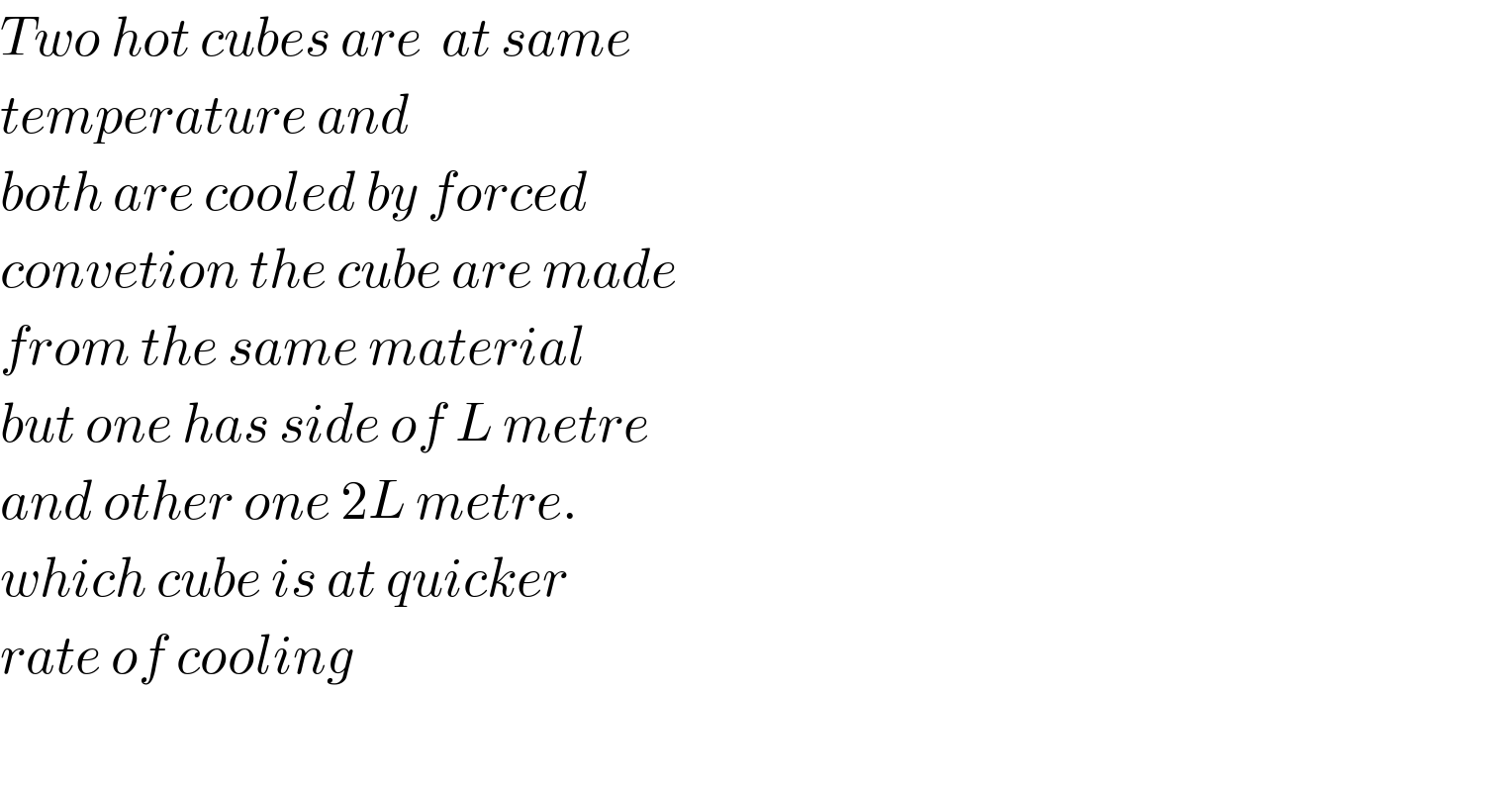
Two hot cubes are at same
temperature and
both are cooled by forced
convetion the cube are made
from the same material
but one has side of L metre
and other one 2L metre.
which cube is at quicker
rate of cooling
1
ans
0
cmts
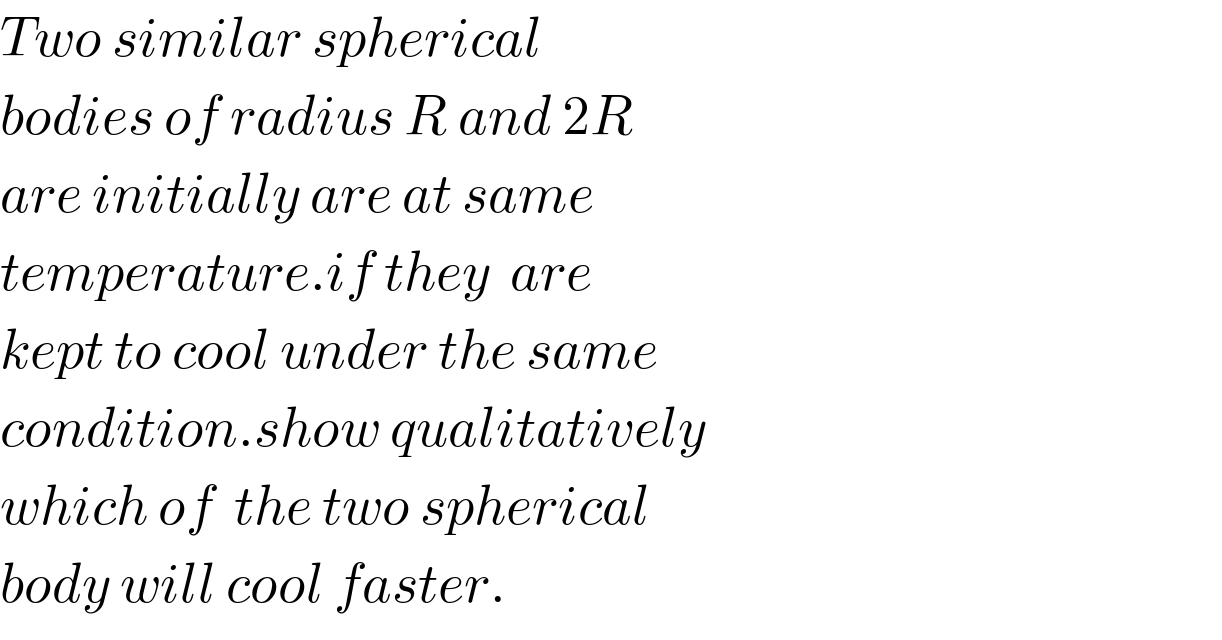
Two similar spherical
bodies of radius R and 2R
are initially are at same
temperature.if they are
kept to cool under the same
condition.show qualitatively
which of the two spherical
body will cool faster.
2
ans
0
cmts
Question 50808
0
ans
0
cmts
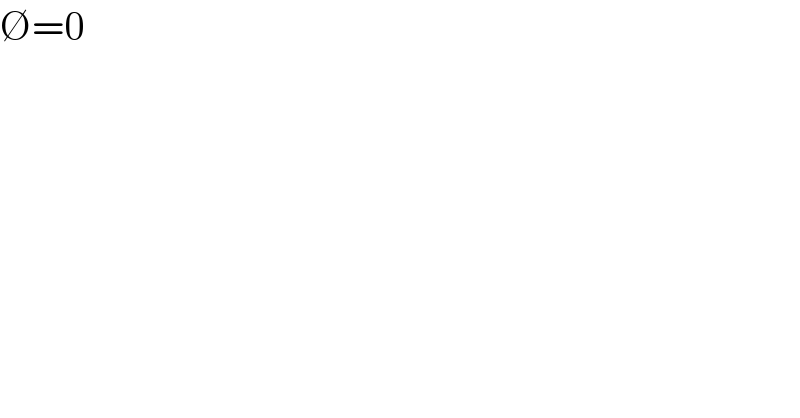
∅=0
1
ans
1
cmts
Question 47377
1
ans
1
cmts
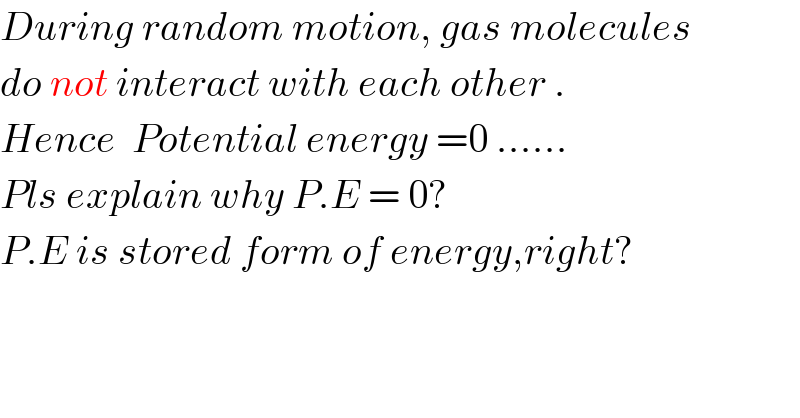
During random motion, gas molecules
do not interact with each other .
Hence Potential energy =0 ......
Pls explain why P.E = 0?
P.E is stored form of energy,right?
0
ans
4
cmts
Question 46790
1
ans
0
cmts
Question 45127