1
ans
0
cmts
Question #228549

1
ans
0
cmts
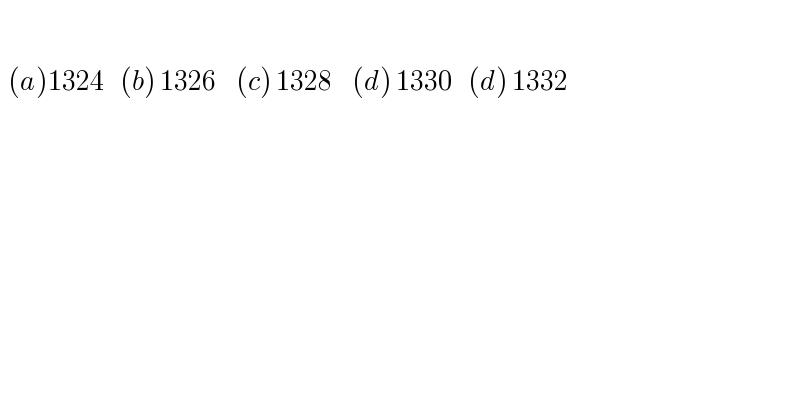
(a)1324 (b) 1326 (c) 1328 (d) 1330 (d) 1332
0
ans
0
cmts
Montrer que :
∀n∈IN^∗ ∫^( n) _( 0) (t^n /(n!)) e^(−t) dt ≥ (1/2)(1−(1/( (√n))))

0
ans
0
cmts
Essaie de corriger sur la trigos
Exercice 2 :
1-Montrons que : ∀x∈R, cos^6 x+sin^6 x=(1/8)(5+3cos4x)
Soit x∈R, On a :
cos^6 x+sin^6 x=(cos^2 x)^3 +(sin^2 x)^3
=(cos^2 x+sin^2 x)^3 −3(sin^2 x)(cos^2 x)(cos^2 x+sin^2 x)
=1−3×(1/4)×2^2 .sin^2 x.cos^2 x
=1−(3/4)(sin^2 2x)
= 1−(3/8)(2sin^2 2x+1−1)
=1−(3/8)(−cos4x+1)
⇒cos^6 x+sin^6 x=(1/8)(5+3cos4x).
2.Re^ solvons ]−π;π] l′e^ quation (E),puis repre^ sentons dans le cercle trigos les solutions:
On a :
(E): cos^6 x+sin^6 x=(3/8)((√3)sin4x−(8/3))
D′apres ce qui pre^ ce^ de,
cos^6 x+sin^6 x=(3/8)((√3)sin4x−(8/3)) ⇒(1/8)(5+3cos4x)=(3/8)((√3)sin4x−(8/3))
⇒cos4x−(√3)sin4x=1
⇒cos ((π/3)+4x)=cos((π/3))
⇒ { ((x_1 =((kπ)/2))),((x_2 =−(π/6)+((kπ)/2))) :} (k∈Z)
determinant ((k,(−2),(−1),0,1,2),(x_1 ,(−π),(−(π/2)),0,(π/2),π),(x_2 ,(−((7π)/6)),(−((2π)/3)),(−(π/6)),(π/3),((5π)/6)))
determinant ((( S_(]−π;π]) ={−(π/2);−((2π)/3);−(π/6);0;(π/3);(π/2);((5π)/6);π} )))
Exercice 18
Soient x,y∈I=[0;(π/2)]/sinx=(((√6)−(√2))/4) et cosy=((√3)/2)
1.Calcule basic (anti 0) :
((((√6)−(√2))/4))^2 =((2−(√3))/4)
2.On a :
cos^2 x+sin^2 y=1⇒cosx=(√(1−sin^2 x)) car x∈I
ie cosx=(((√6)+(√2))/4)
3.De me^ me siny=(√(1−cos^2 y)) ie siny=(1/2)
il est evident que y=(π/6)
4. On a cos(x+y)=cosxcosy−sinxsiny
=(((√6)+(√2))/4) .((√3)/2)−(((√6)−(√2))/4).(1/2)
donc cos(x+y)=((√2)/2)
on a alors cos(x+y)=((√2)/2) ⇒x+y=(π/4) ie x=(π/(12))
5.Soit x∈R , sin^2 xcos^3 x=cosx(sin^2 x(1−sin^2 x))
ie sin^2 xcos^3 x=cosx(sin^2 x−sin^4 x)
donc ∀x∈R , sin^2 xcos^3 x=cosx(sin^2 x(1−sin^2 x))
Exercice 14
1 Re^ solvons dans R l′e^ quation: 2t^2 +(√3)t−3=0
Δ=27⇒(√Δ)=3(√3)
donc { ((t_1 =((−(√3)+3(√3))/(2(2))) )),((t_2 =((−(√3)−3(√3))/(2(2))) )) :} ⇒ { ((t_1 =((√3)/2))),((t_2 =−(√3))) :}
d′ou^ determinant ((( S_R ={−(√3);((√3)/2)})))
2.De^ terminons (r;ϕ)∈R_+ ×]0;2π[ /(√3)cosx+sin x=rcos(x−ϕ) :
(√3)cosx+sin x=2(((√3)/2)cosx+(1/2)sinx)
=2(cos((π/6))cosx+sin((π/6))sinx)
⇒(√3)cosx+sin x=2cos(x−(π/6))
donc (r;ϕ)=(2;(π/6))
3.Re^ solvons dans ]0;2π] l′e^ quation (E) :
(E):(2sin^2 x+(√3)sinx−3)( (√3)cosx+sin x−(√2))=0⇔2sin^2 x+(√3)sinx−3=0 ou (√3)cosx+sin x−(√2)=0
• 2sin^2 x+(√3)sinx−3=0
Posons t=sinx⇒2t^2 +(√3)t−3=0
i.e { ((t=((√3)/2))),((t=−(√3))) :}⇒sinx=((√3)/2)
=sin((π/3))
donc { ((x_1 =(π/3)+2kπ )),((x_2 =(π/3)+2(k−1)π)) :}(k∈Z)
determinant ((k,(−2),(−1),0,1,2),(x_1 ,(−((11π)/3)),(−((2π)/3)),(π/3),((8π)/3),((13π)/3)),(x_2 ,(−((14π)/3)),(−((8π)/3)),(−((2π)/3)),((4π)/3),((10π)/3)))
determinant (((S_(]0;2π]) ={(π/3);((4π)/3)})))
• (√3)cosx+sin x−(√2)=0 ⇒cos(x−(π/6))=((√2)/2)
=cos((π/4))
donc { ((x_1 =((5π)/(12))+2kπ)),((x_2 =−(π/(12))+2kπ)) :} (k∈Z)
determinant ((k,(−2),(−1),0,1,2),(x_1 ,(−((43π)/(12))),(−((19π)/(12))),((5π)/(12)),((29π)/(12)),((53π)/(12))),(x_2 ,(−((49π)/(12))),(−((25π)/(12))),(−(π/(12))),((23π)/(12)),((47π)/(12))))
determinant (((S_(]0;2π]) ={((5π)/(12));((23π)/(12))})))
Exercice 39
Soit x∈]0;2π]
1.Montrons que A(x)=4cos2x
On a:
A(x)=((cos3x)/(cosx))+((sin3x)/(sinx))
= ((sinx(cosx.cos2x−sin2x.sinx)+cosx(sin2x.cosx+cos2x.sinx))/(cosx.sinx))
=((sinx.cosx.cos2x−sin^2 x.sin2x+cos^2 x.sin2x+cos2x.sinx.cosx)/(cosx.sinx))
=((sin2x cos2x−2sin2x.sin^2 x+2cos^2 x.sin2x+cos2x.sin2x)/(sin2x))
=cos2x−2sin^2 x+2cos^2 x+cos2x
=2cos2x+2(cos^2 x−sin^2 x)
⇒A(x)=4cos2x
2.Re^ solvons A(x)=B(x)
A(x)=B(x)⇔4cos2x=4(1−(√3)sin2x)
⇔cos2x+(√3)sin2x=1
⇔cos(2x−(π/3))=(1/2)
=cos ((π/3))
⇒ { ((x_1 =(π/3)+kπ)),((x_2 =kπ)) :} (k∈Z)
determinant ((k,(−2),(−1),0,1,2),(x_1 ,(−((5π)/3)),(−((2π)/3)),(π/3),((4π)/3),((7π)/3)),(x_2 ,(−2π),(−π),0,π,(2π)))
determinant (((S_(]0;2π[) ={(π/3);π;((4π)/3)})))
Exercice 34
1. Montrons que (E_1 ) et (E_2 ) sont e^ quivalent
Soit x∈[0;2π], on a :
(E_1 ):sinx.cosx+cos^2 x=cos2x⇒sinx.cosx+cos^2 x=cos^2 x−sin^2 x
⇒sinx.cosx+sin^2 x=0
donc (E_1 )⇒(E_2 ).
(E_2 ):sinx.cosx+sin^2 x=0⇒sinx.cosx=−sin^2 x
⇒ sinx.cosx+cos^2 x=cos^2 x−sin^2 x
donc (E_2 )⇒(E_1 ).
Conclusion: (E_1 )⇔(E_2 )
2.Re^ solvons dans [0;2π] l′e^ quation (E_1 ) :
On a :
(E_1 ):sinx.cosx+cos^2 x=cos2x ⇔ sinx(cosx+sinx)=0
⇔ sinx.cos(x−(π/4))=0
⇔ sinx=0 ou cos(x−(π/4))=0
•sinx=0⇒x_1 =2kπ (k∈Z)
•cos(x−(π/4))=0⇒ { ((x_2 =((3π)/4)+2kπ)),((x_3 =−(π/4)+2kπ)) :} (k∈Z)
determinant ((k,0,1,2),(x_1 ,0,(2π),(4π)),(x_2 ,(((3π)/4) ),((11π)/4),((19π)/4)),(x_3 ,(−(π/4)),((7π)/4),((15π)/4)))
determinant (((S_(]0;2π[) ={0;((3π)/4);((7π)/4);((11π)/4);2π})))
Exercice 27
1.Re^ solvons dans [−π;π[ l′e^ quation (E): cos^2 2x=(1/2)
On a :
cos^2 2x=(1/2) ⇔cos2x=((√2)/2) ou cos2x=−((√2)/2)
⇔ { ((x_1 =(π/8)+kπ)),((x_2 =−(π/8)+kπ)) :} (k∈Z) ou { ((x_3 =((3π)/8)+kπ)),((x_4 =−((3π)/8)+kπ)) :}(k∈Z)
determinant ((k,(−2),(−1),0,1,2),(x_1 ,(−((15π)/8)),(−((7π)/8)),(π/8),((9π)/8),((17π)/8)),(x_2 ,(−((17π)/8)),(−((9π)/8)),(−(π/8)),((7π)/8),((15π)/8)),(x_3 ,(−((13π)/8)),(−((5π)/8)),((3π)/8),((11π)/8),((19π)/8)),(x_4 ,(−((19π)/8)),(−((11π)/8)),(−((3π)/8)),((5π)/8),((13π)/8)))
determinant ((( S_([−π;π[) ={−((7π)/8);−((5π)/8);−((3π)/8);−(π/8);(π/8);((3π)/8);((5π)/8);((7π)/8)} )))
2

1
ans
1
cmts
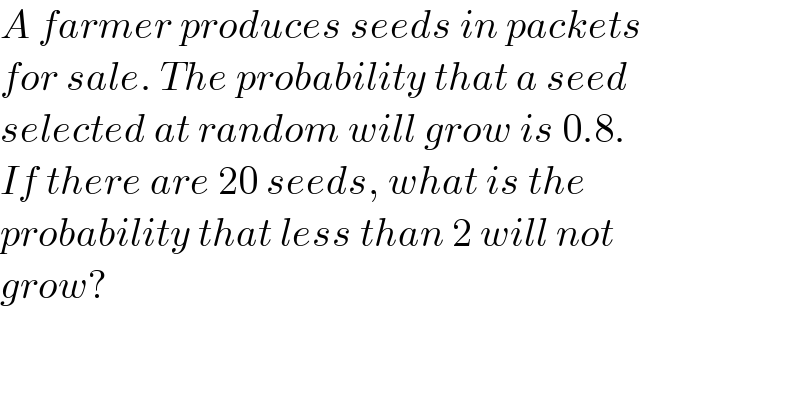
A farmer produces seeds in packets
for sale. The probability that a seed
selected at random will grow is 0.8.
If there are 20 seeds, what is the
probability that less than 2 will not
grow?
0
ans
0
cmts
Question 224499
2
ans
0
cmts
Question 224476
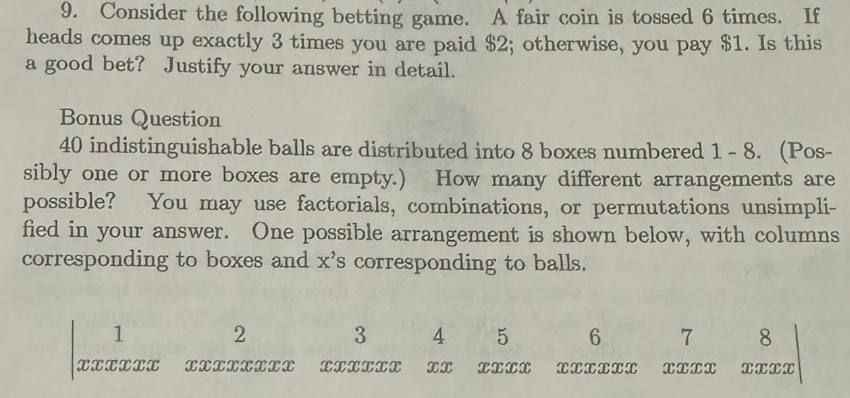
0
ans
0
cmts
Question 224475
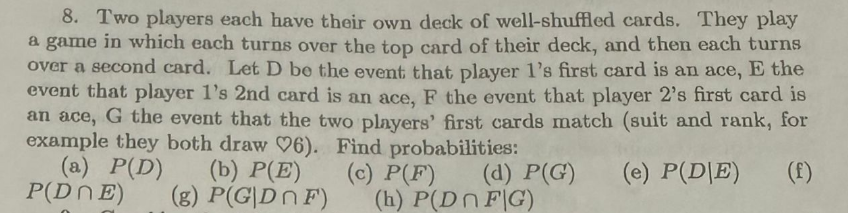
1
ans
0
cmts
Question 224399

1
ans
1
cmts
?
0
ans
0
cmts
Question 223482
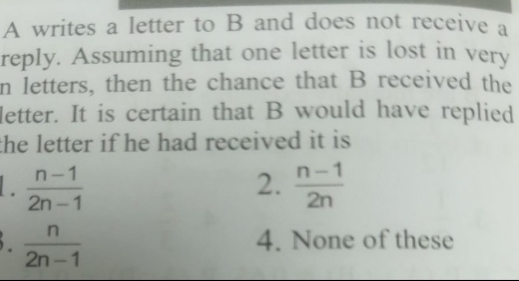
0
ans
1
cmts
Question 222652
0
ans
4
cmts
A bag contains 5 identical balls of which
there is one red, one blue and the rest are
white. What is the probability of selecting
at least one white balls, if 3 balls are selected.

0
ans
0
cmts
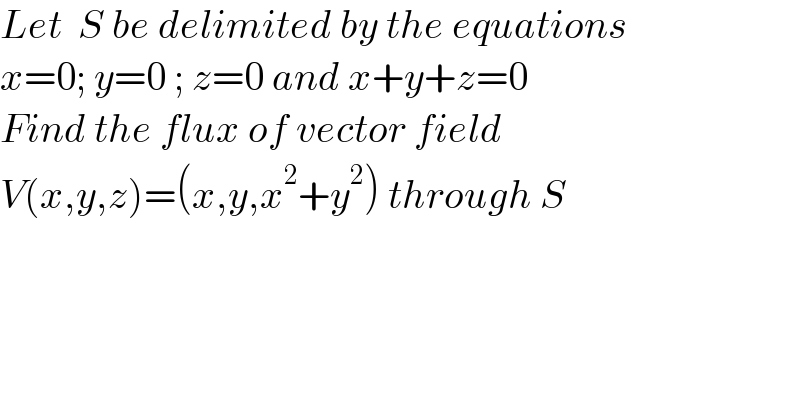
Let S be delimited by the equations
x=0; y=0 ; z=0 and x+y+z=0
Find the flux of vector field
V(x,y,z)=(x,y,x^2 +y^2 ) through S
2
ans
0
cmts
Question 221052
0
ans
0
cmts
Question 220628
3
ans
0
cmts
Question 220627
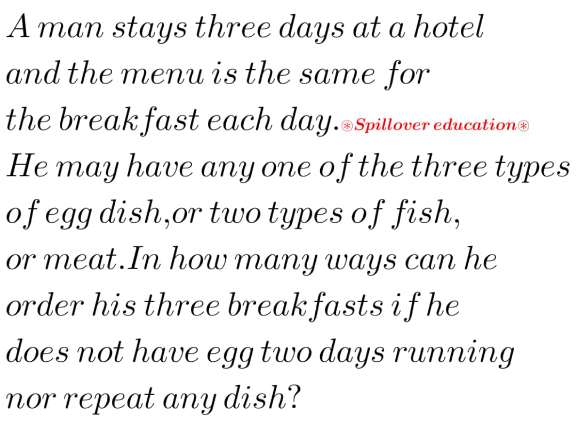
2
ans
0
cmts
Question 220626
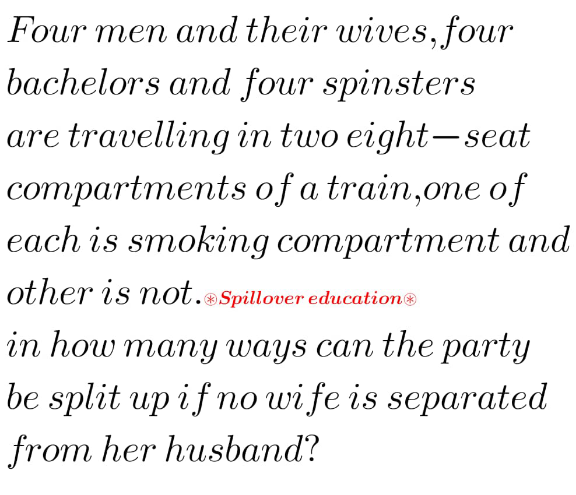
1
ans
0
cmts
Question 220625
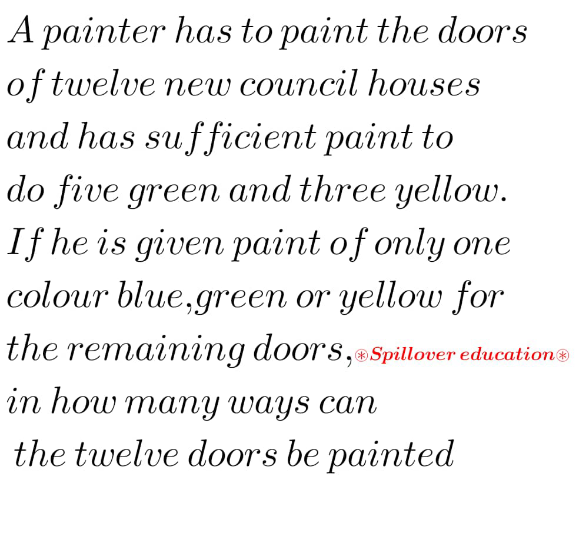
0
ans
0
cmts
Question 220538
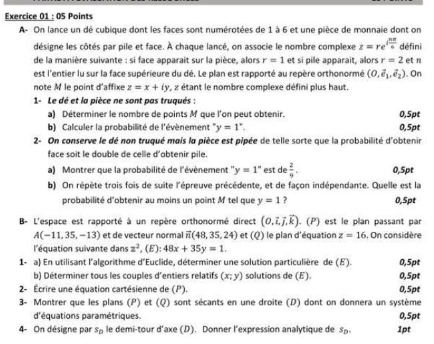
0
ans
0
cmts
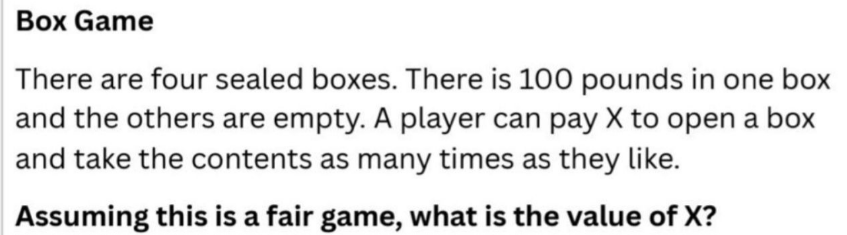
Question 220378
0
ans
0
cmts
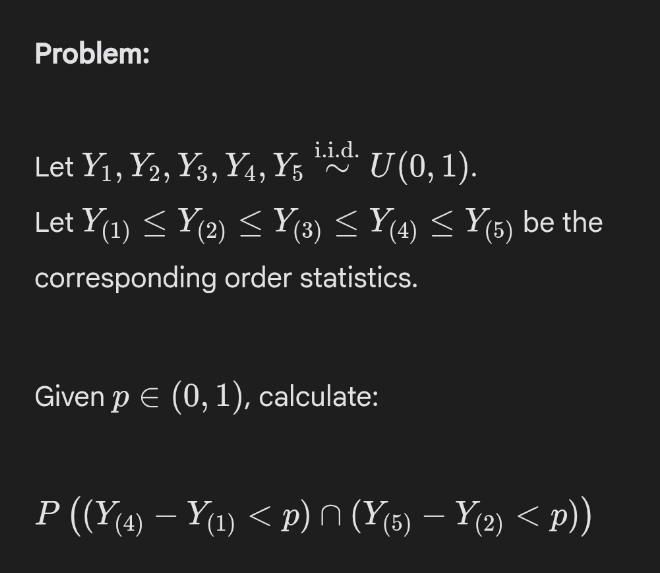
Question 220074
0
ans
0
cmts
Suppose that an urn contains 100,000 marbles
and 120 are red . If a random sample of 1000 is
drawn, what are the probabilities that 0,1,2,3 and
4 respectively will be red. What is the mean and
variance?

0
ans
0
cmts
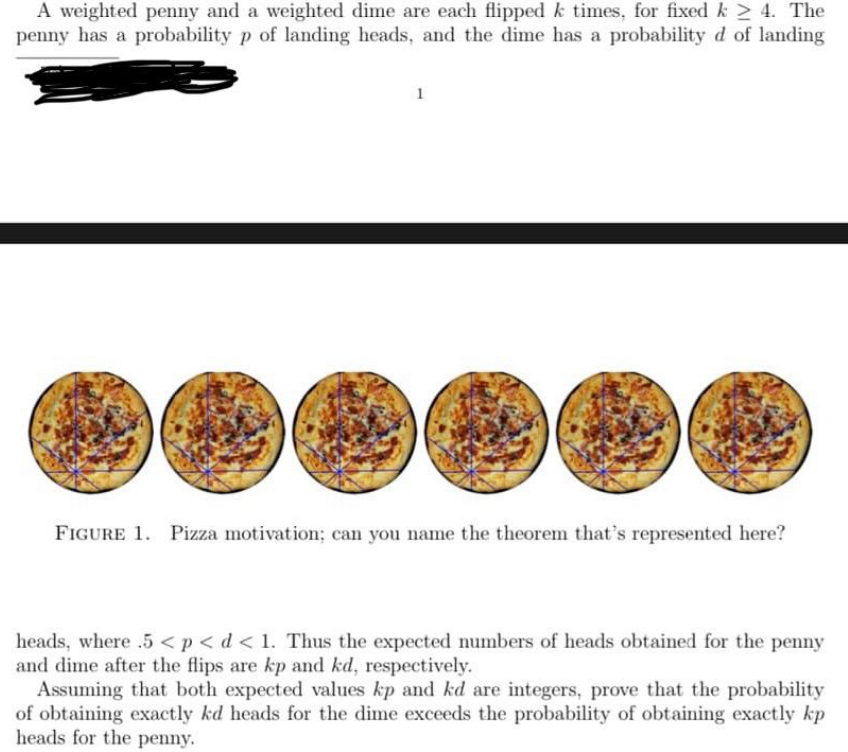
Question 218437
0
ans
15
cmts
If two fair dice is thrown twice, what is the
probability of obtaining an even number

1
ans
0
cmts
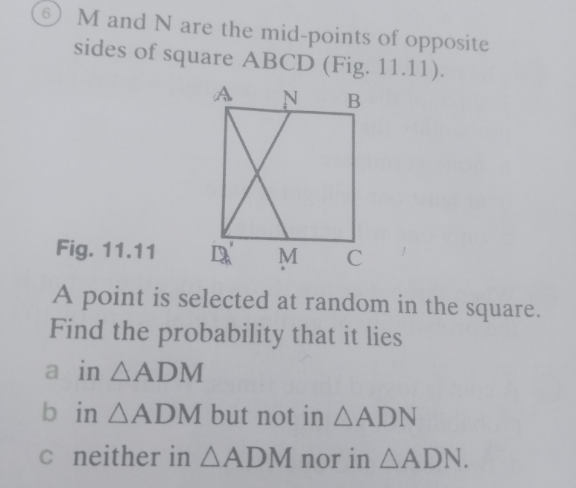
Question 217818
1
ans
0
cmts
Question 217617
0
ans
1
cmts
40 random numbers picked from 0 to 100. what is the probability that at least half of them has the range of 10.

0
ans
0
cmts
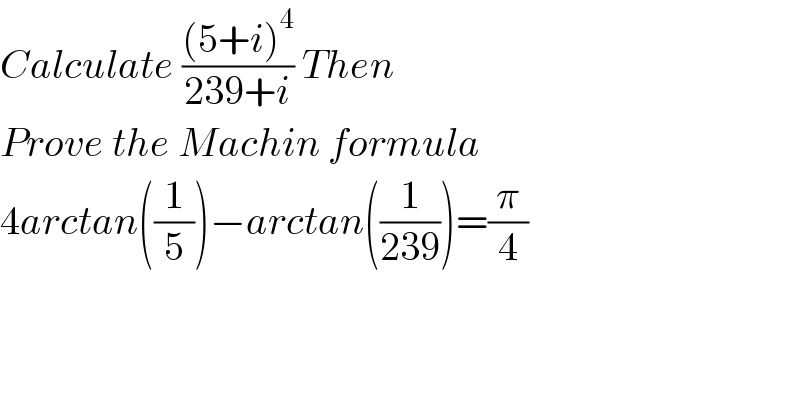
Calculate (((5+i)^4 )/(239+i)) Then
Prove the Machin formula
4arctan((1/5))−arctan((1/(239)))=(π/4)
1
ans
2
cmts
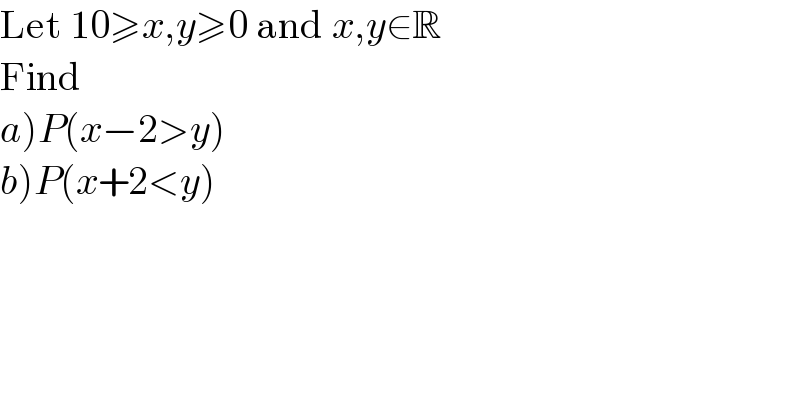
Let 10≥x,y≥0 and x,y∈R
Find
a)P(x−2>y)
b)P(x+2<y)
1
ans
0
cmts
Question 216161
1
ans
0
cmts
3 different integer numbers are chosen from 0 to 10. what is the probability that they form
1 Cluster
3 Clusters
2 Clusters
A cluster is a set of numbers that has maximum range of 2. for example 0,1,2 forms only one cluster. 0,1,4 forms 2 {0,1} and {4}. 0,1,3 also forms 2 {0,1} and {1,2}

0
ans
0
cmts
3 numbers are selected randomly from 0 to 10 (Continuous). forming a new range. what is the probability that the new range is less than or equal to 2?
new range = max-min

0
ans
0
cmts
Question 213428
2
ans
0
cmts
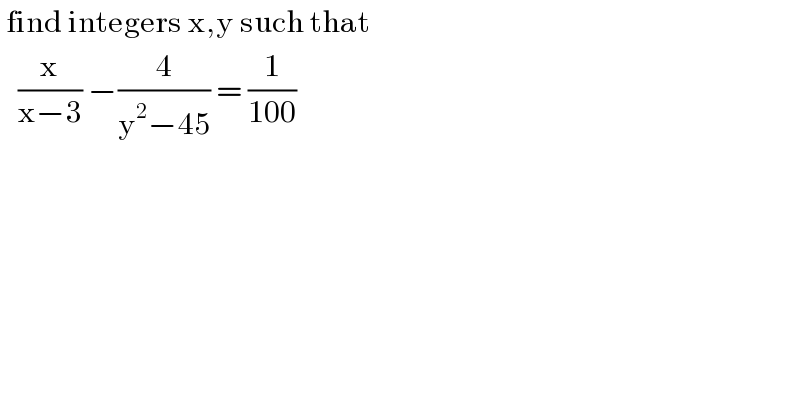
find integers x,y such that
(x/(x−3)) −(4/(y^2 −45)) = (1/(100))
2
ans
1
cmts
If the probability of A solving a question is 1/2 and the probability of B solving the question is 2/3 then the probability of the question being solved is

1
ans
0
cmts
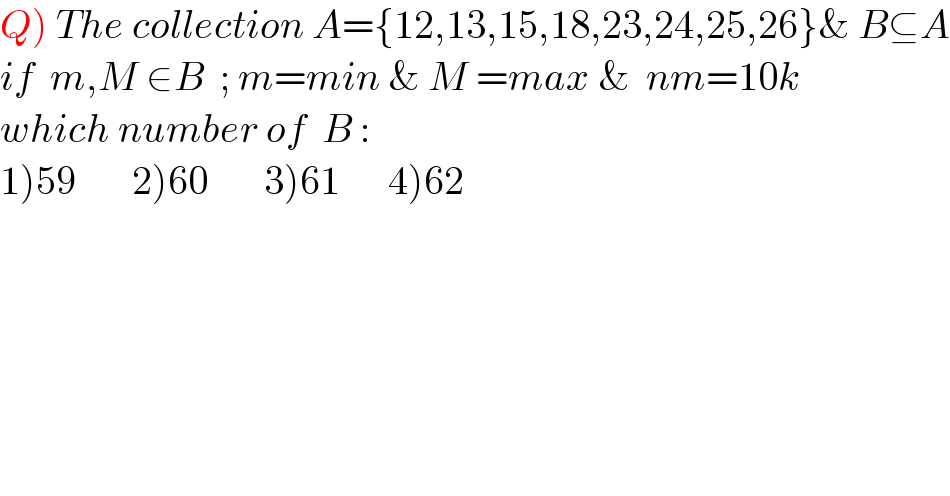
Q) The collection A={12,13,15,18,23,24,25,26}& B⊆A
if m,M ∈B ; m=min & M =max & nm=10k
which number of B :
1)59 2)60 3)61 4)62
0
ans
0
cmts
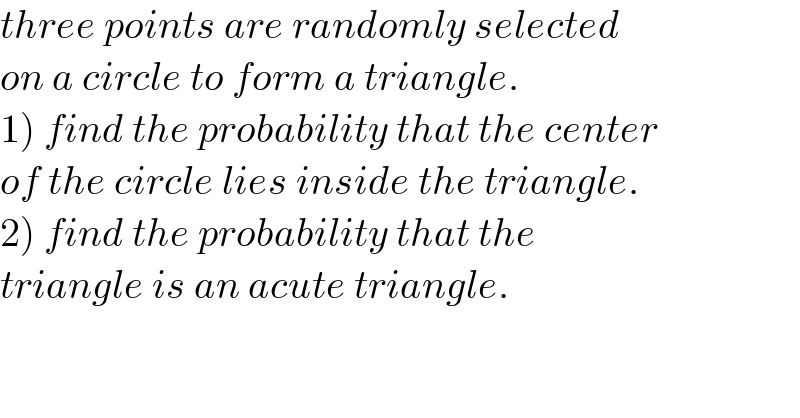
three points are randomly selected
on a circle to form a triangle.
1) find the probability that the center
of the circle lies inside the triangle.
2) find the probability that the
triangle is an acute triangle.
1
ans
2
cmts
Question 209424
1
ans
0
cmts
Question 209031
1
ans
0
cmts
Question 208812
1
ans
0
cmts
n married couples are invited to
a dance party. for the first dance
n paires are radomly selected.
what′s the probability that no woman
dances with her own husband?
1) if a pair must be of different
genders.
2) if a pair can also be of the same
gender.

1
ans
3
cmts
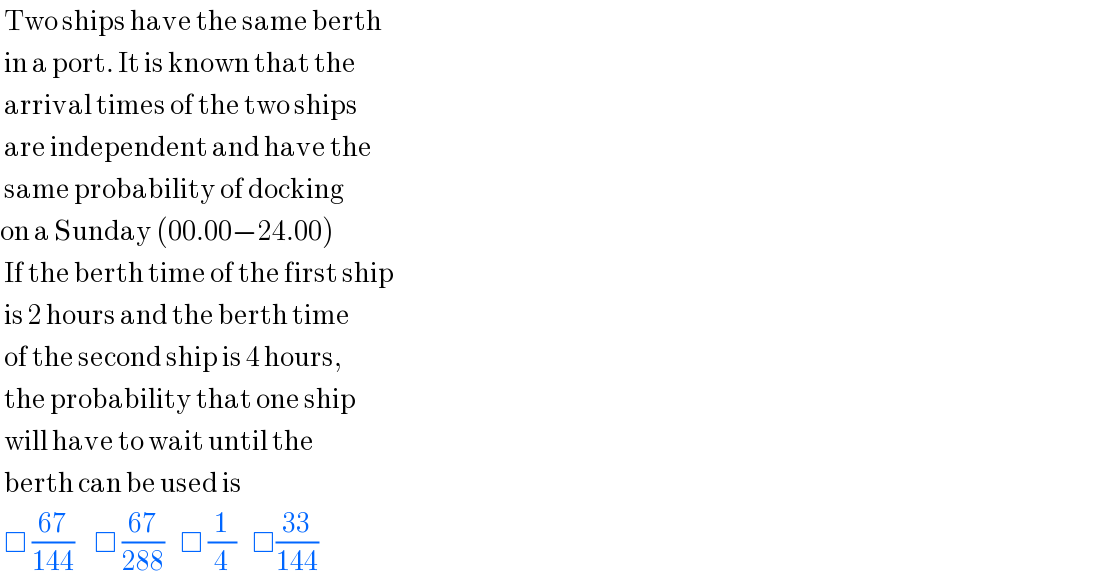
Two ships have the same berth
in a port. It is known that the
arrival times of the two ships
are independent and have the
same probability of docking
on a Sunday (00.00−24.00)
If the berth time of the first ship
is 2 hours and the berth time
of the second ship is 4 hours,
the probability that one ship
will have to wait until the
berth can be used is
□ ((67)/(144)) □ ((67)/(288)) □ (1/4) □((33)/(144))
0
ans
0
cmts
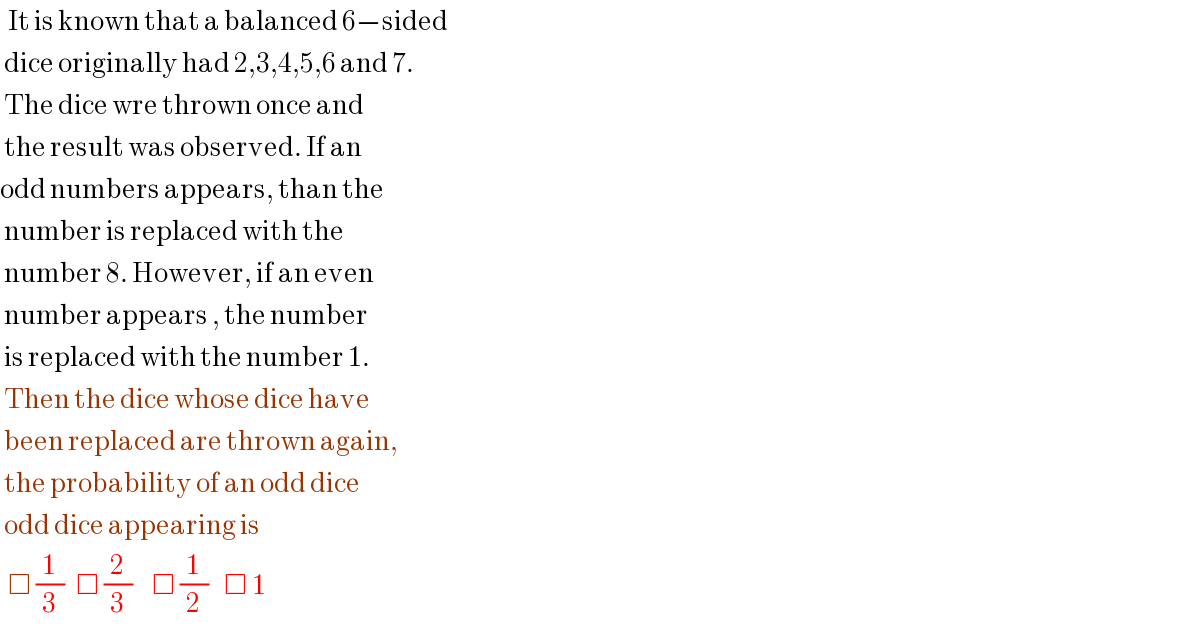
It is known that a balanced 6−sided
dice originally had 2,3,4,5,6 and 7.
The dice wre thrown once and
the result was observed. If an
odd numbers appears, than the
number is replaced with the
number 8. However, if an even
number appears , the number
is replaced with the number 1.
Then the dice whose dice have
been replaced are thrown again,
the probability of an odd dice
odd dice appearing is
□ (1/3) □ (2/3) □ (1/2) □ 1
3
ans
0
cmts
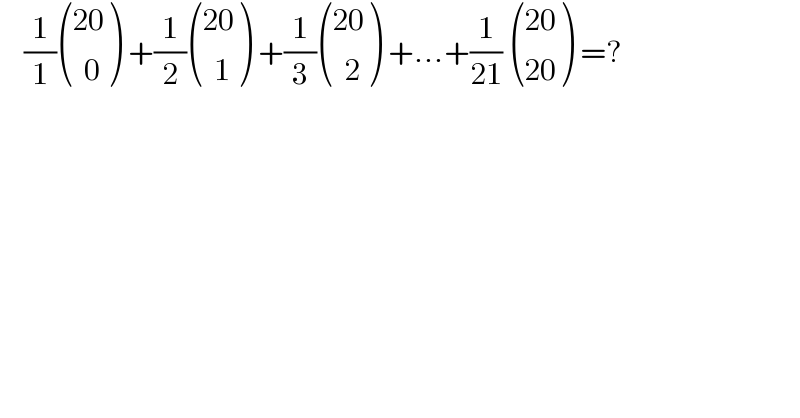
(1/1) (((20)),(( 0)) ) +(1/2) (((20)),(( 1)) ) +(1/3) (((20)),(( 2)) ) +...+(1/(21)) (((20)),((20)) ) =?
1
ans
0
cmts
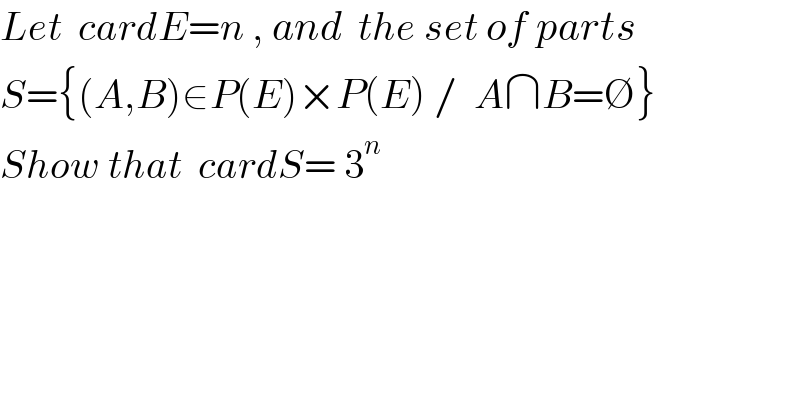
Let cardE=n , and the set of parts
S={(A,B)∈P(E)×P(E) / A∩B=∅}
Show that cardS= 3^n
2
ans
0
cmts
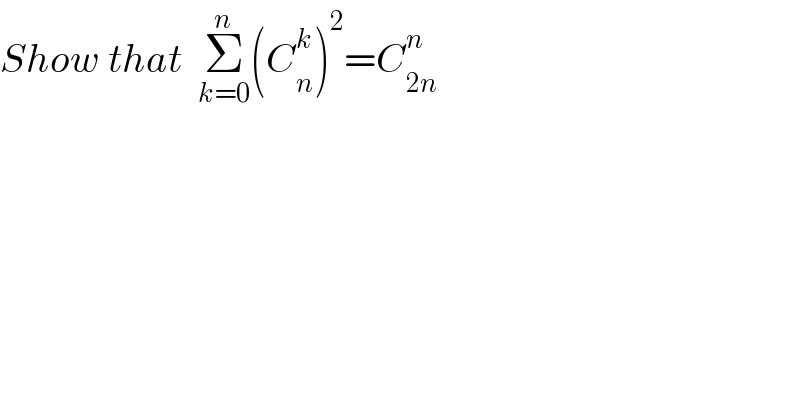
Show that Σ_(k=0) ^n (C_n ^k )^2 =C_(2n) ^n
0
ans
0
cmts
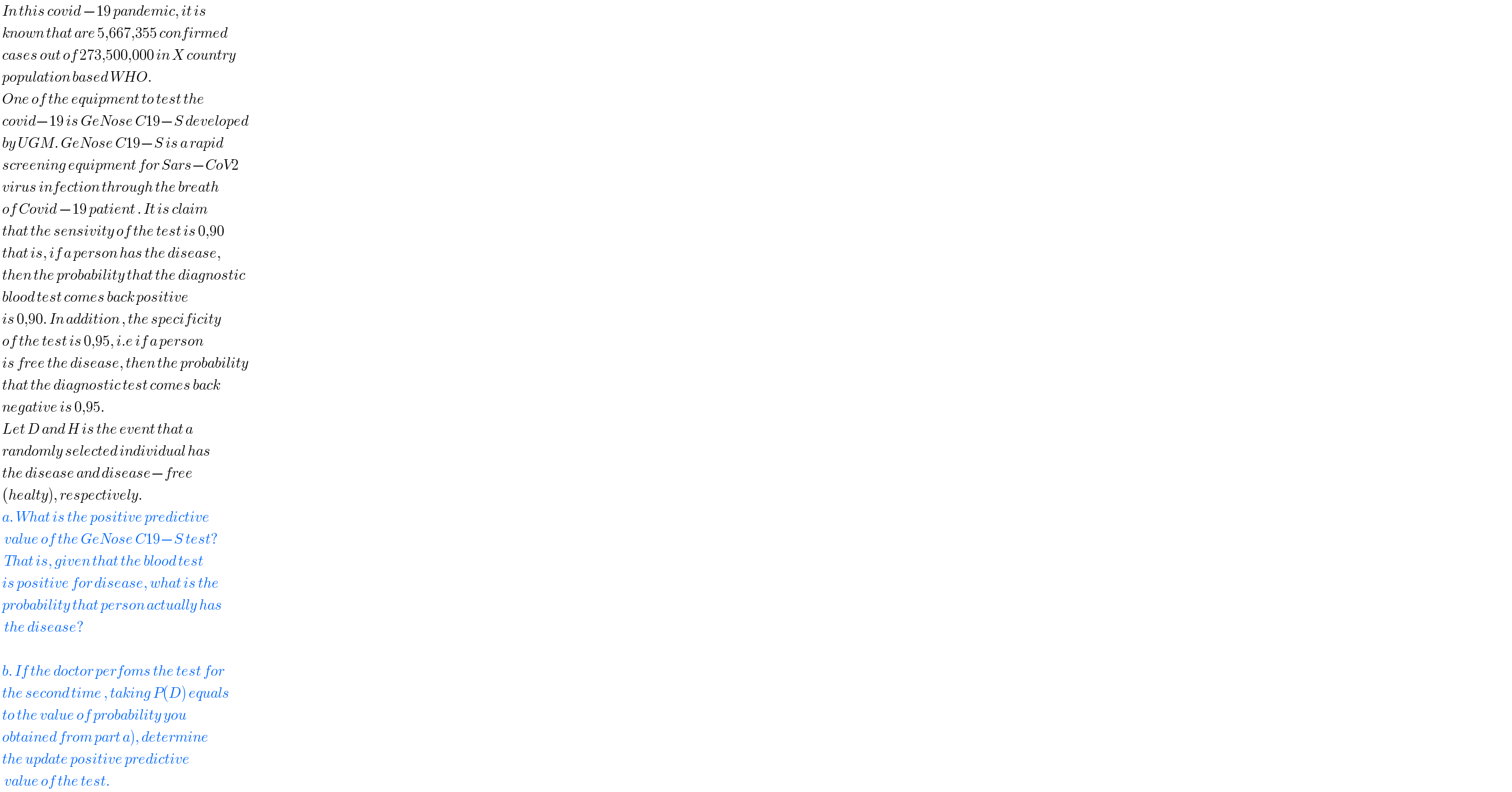
In this covid −19 pandemic, it is
known that are 5,667,355 confirmed
cases out of 273,500,000 in X country
population based WHO.
One of the equipment to test the
covid−19 is GeNose C19−S developed
by UGM. GeNose C19−S is a rapid
screening equipment for Sars−CoV2
virus infection through the breath
of Covid −19 patient . It is claim
that the sensivity of the test is 0,90
that is, if a person has the disease,
then the probability that the diagnostic
blood test comes back positive
is 0,90. In addition , the specificity
of the test is 0,95, i.e if a person
is free the disease, then the probability
that the diagnostic test comes back
negative is 0,95.
Let D and H is the event that a
randomly selected individual has
the disease and disease−free
(healty), respectively.
a. What is the positive predictive
value of the GeNose C19−S test?
That is, given that the blood test
is positive for disease, what is the
probability that person actually has
the disease?
b. If the doctor perfoms the test for
the second time , taking P(D) equals
to the value of probability you
obtained from part a), determine
the update positive predictive
value of the test.
0
ans
0
cmts
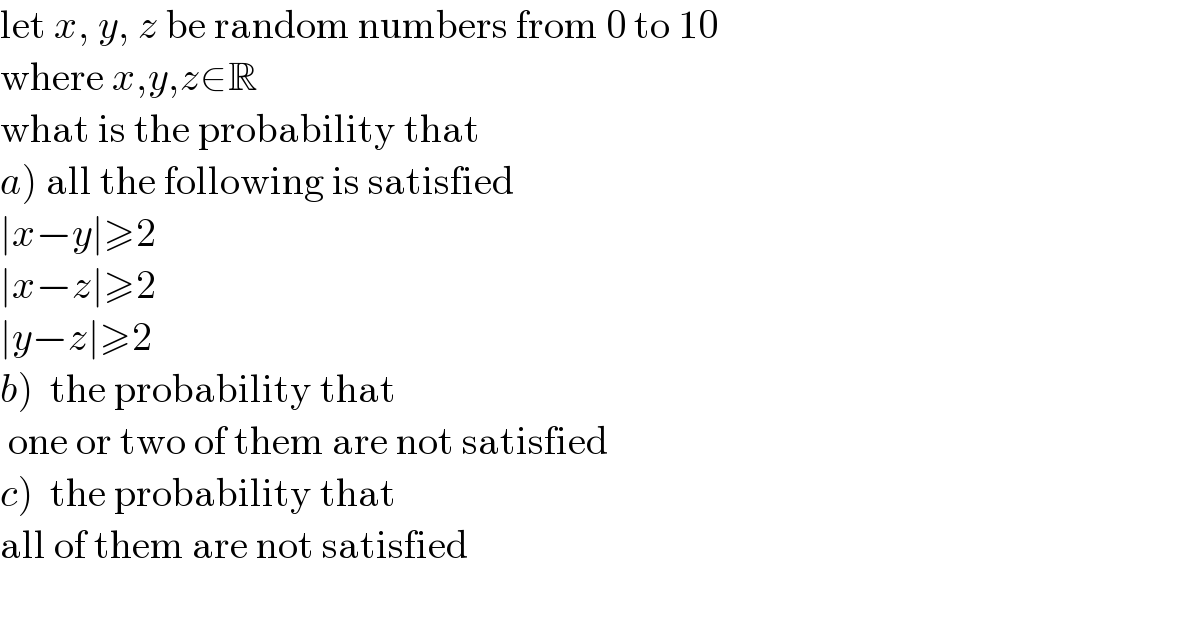
let x, y, z be random numbers from 0 to 10
where x,y,z∈R
what is the probability that
a) all the following is satisfied
∣x−y∣≥2
∣x−z∣≥2
∣y−z∣≥2
b) the probability that
one or two of them are not satisfied
c) the probability that
all of them are not satisfied
1
ans
0
cmts
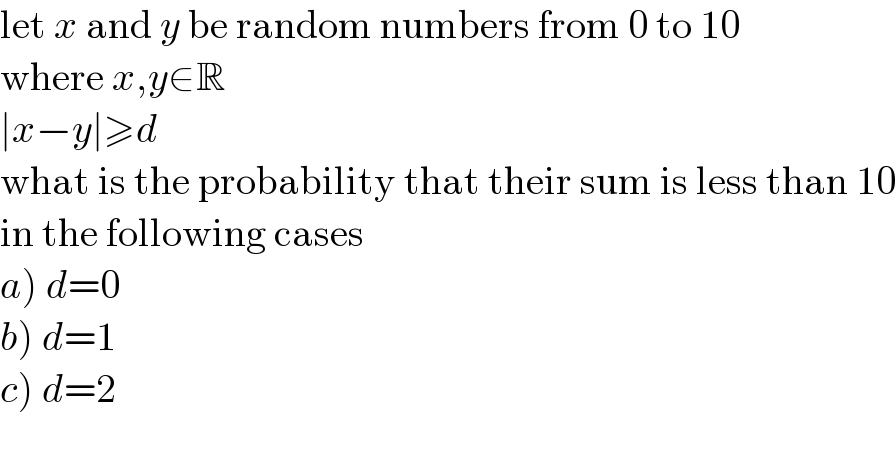
let x and y be random numbers from 0 to 10
where x,y∈R
∣x−y∣≥d
what is the probability that their sum is less than 10
in the following cases
a) d=0
b) d=1
c) d=2