1
ans
3
cmts
Question 215608
1
ans
1
cmts
Question 212593
1
ans
0
cmts
Question 212514
2
ans
1
cmts
Question 203726
0
ans
3
cmts
Question 203688
1
ans
1
cmts
Question 203636
0
ans
0
cmts
Question 202870
0
ans
0
cmts
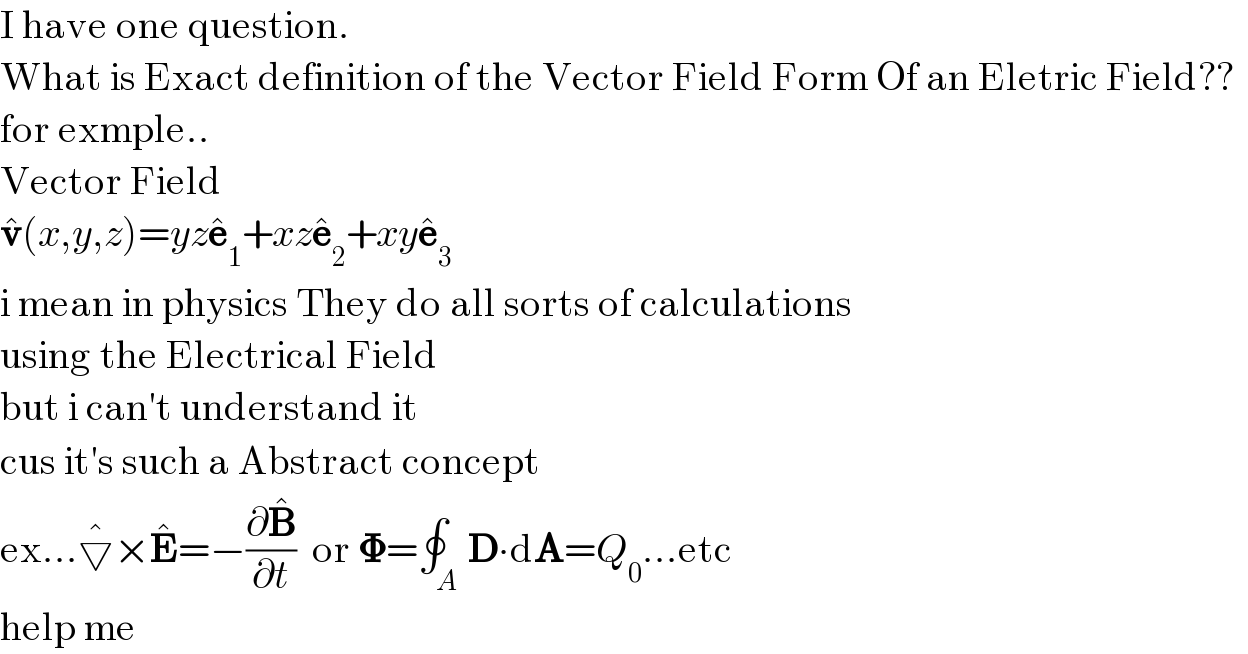
I have one question.
What is Exact definition of the Vector Field Form Of an Eletric Field??
for exmple..
Vector Field
v^ (x,y,z)=yze_1 ^ +xze_2 ^ +xye_3 ^
i mean in physics They do all sorts of calculations
using the Electrical Field
but i can′t understand it
cus it′s such a Abstract concept
ex...▽^ ×E^ =−(∂B^ /∂t) or 𝚽=∮_A D∙dA=Q_0 ...etc
help me
1
ans
0
cmts
Question 190814
0
ans
0
cmts
Question #172286

1
ans
0
cmts
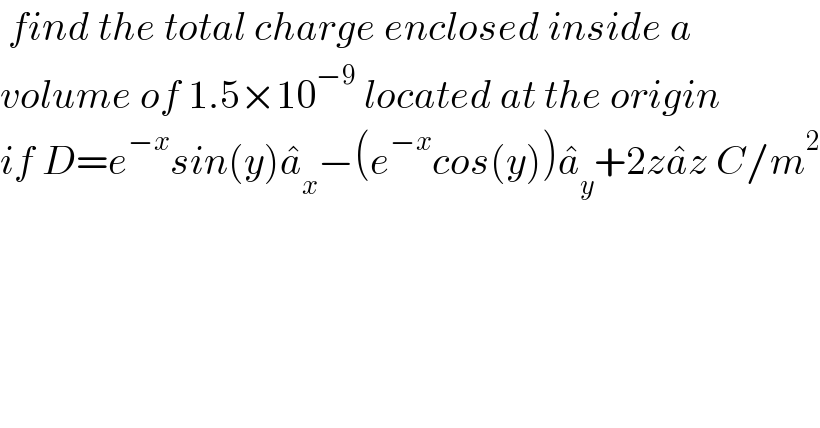
find the total charge enclosed inside a
volume of 1.5×10^(−9) located at the origin
if D=e^(−x) sin(y)a_x ^ −(e^(−x) cos(y))a_y ^ +2za^ z C/m^2
0
ans
0
cmts
Question 163618
1
ans
0
cmts
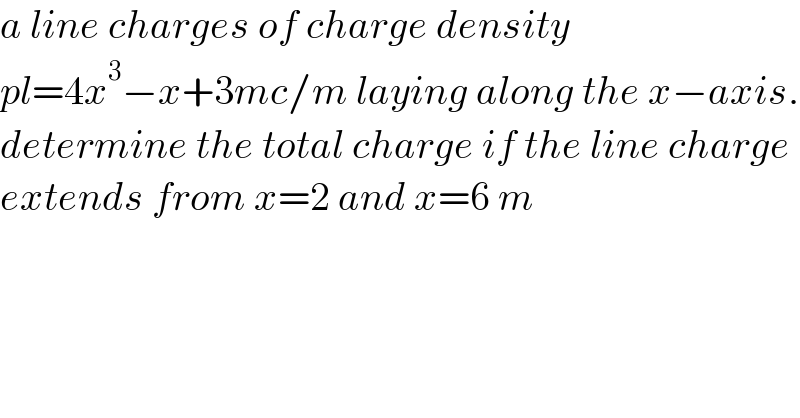
a line charges of charge density
pl=4x^3 −x+3mc/m laying along the x−axis.
determine the total charge if the line charge
extends from x=2 and x=6 m
0
ans
0
cmts
Question 157241
1
ans
0
cmts
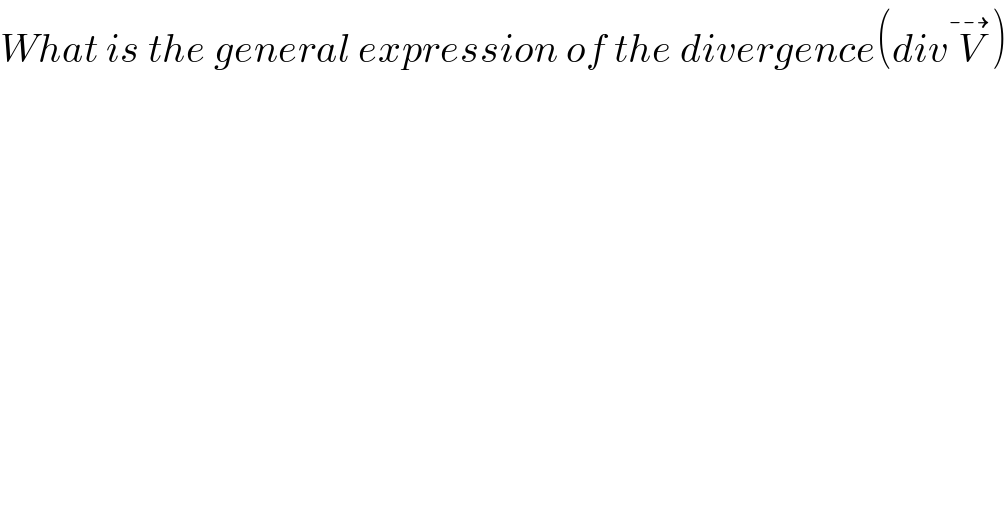
What is the general expression of the divergence(divV^⇢ )
0
ans
0
cmts
Question 155236
0
ans
1
cmts
Question 140020
0
ans
0
cmts
Question 131377
0
ans
0
cmts
Question 130272
0
ans
0
cmts
Question 130025
0
ans
0
cmts
Question 128227
0
ans
0
cmts
Question 128115
0
ans
0
cmts
Question 117010
0
ans
0
cmts
Question 116900
0
ans
1
cmts
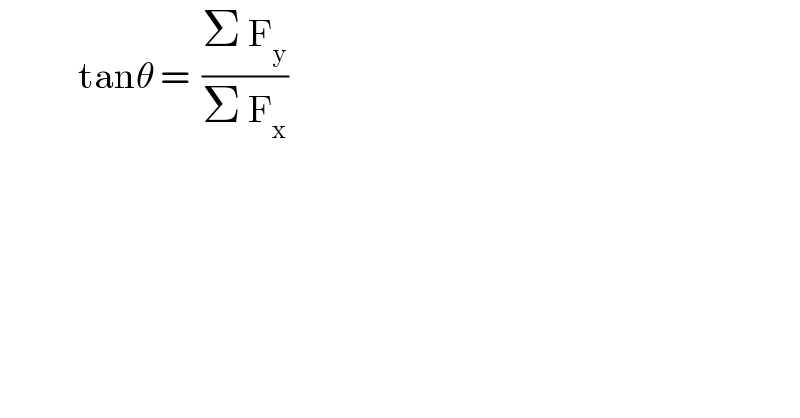
tanθ = ((Σ F_y )/(Σ F_x ))
0
ans
0
cmts
Question 105242

1
ans
1
cmts
Question 104572
0
ans
2
cmts
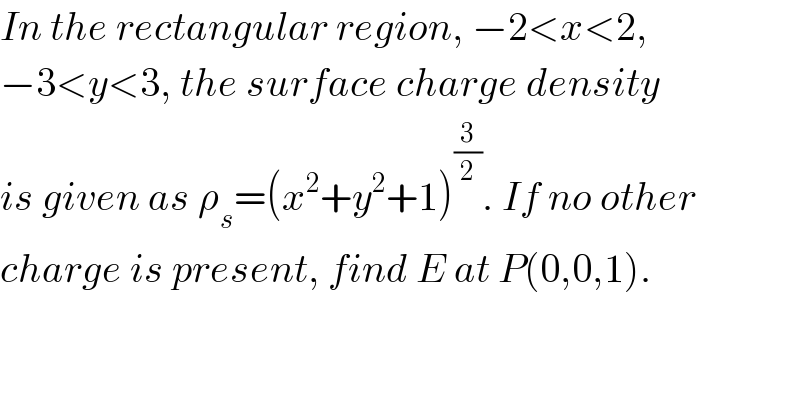
In the rectangular region, −2<x<2,
−3<y<3, the surface charge density
is given as ρ_s =(x^2 +y^2 +1)^(3/2) . If no other
charge is present, find E at P(0,0,1).
0
ans
1
cmts
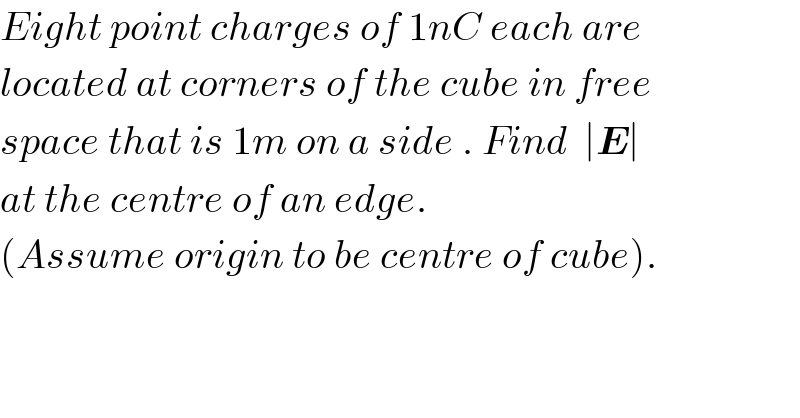
Eight point charges of 1nC each are
located at corners of the cube in free
space that is 1m on a side . Find ∣E∣
at the centre of an edge.
(Assume origin to be centre of cube).
0
ans
1
cmts
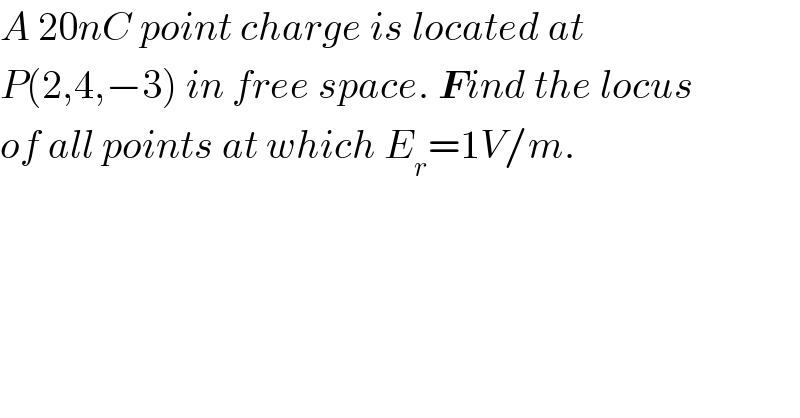
A 20nC point charge is located at
P(2,4,−3) in free space. Find the locus
of all points at which E_r =1V/m.
0
ans
12
cmts
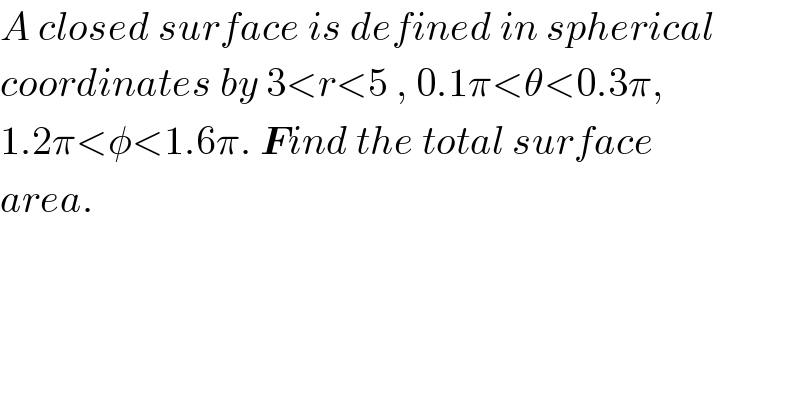
A closed surface is defined in spherical
coordinates by 3<r<5 , 0.1π<θ<0.3π,
1.2π<φ<1.6π. Find the total surface
area.
0
ans
1
cmts
Question 74423
0
ans
0
cmts
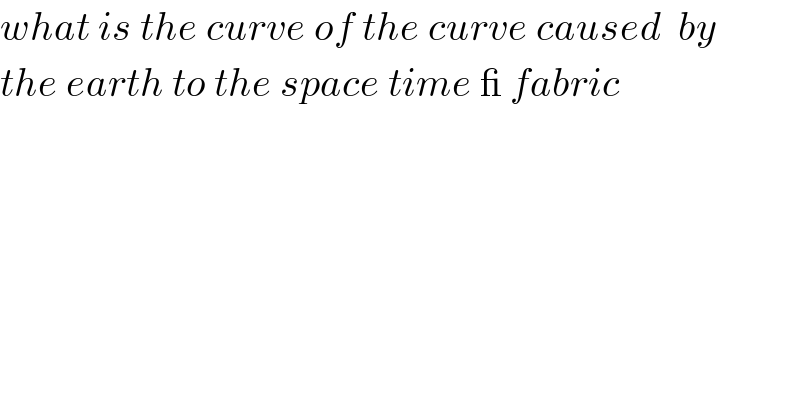
what is the curve of the curve caused by
the earth to the space time _ fabric
1
ans
5
cmts
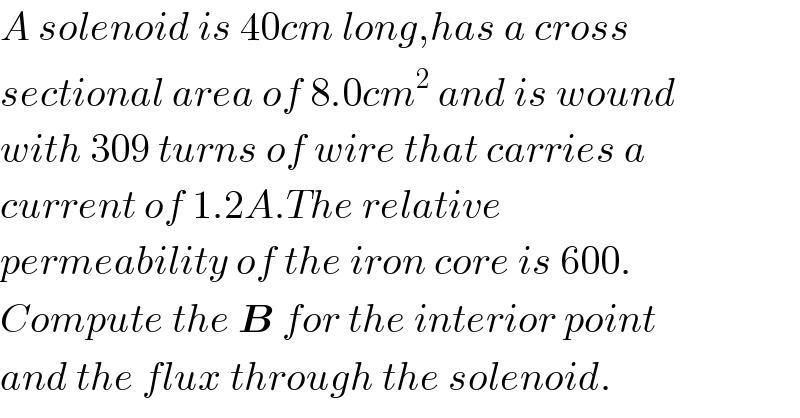
A solenoid is 40cm long,has a cross
sectional area of 8.0cm^2 and is wound
with 309 turns of wire that carries a
current of 1.2A.The relative
permeability of the iron core is 600.
Compute the B for the interior point
and the flux through the solenoid.
0
ans
0
cmts
Question 59958
1
ans
0
cmts
Question 59703
1
ans
0
cmts
Question 57783
0
ans
0
cmts
Question 55853
1
ans
1
cmts
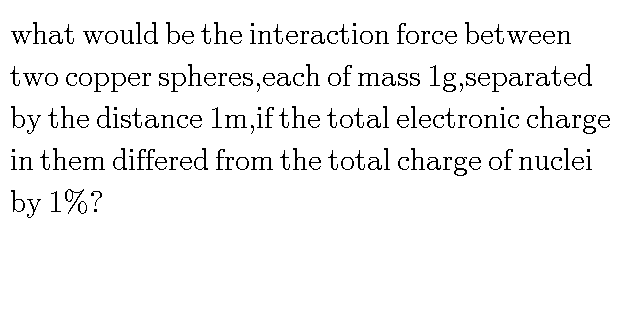
2 plane parallel conducting plates are
held horizontal,one above the other in
a vacuum.Electrons having a speed of
6×10^6 m/s and moves normally to the
plates enter the region between them
through a hole in the lower plate which
is earthed.What potential must be
applied to the other plate so that the
electrons just fails to reach it?What
is the subsequent motion of these
electrons?
(ratio of charge to mass of electron=
1.8×10^(11) Ckg^(−1) )
1
ans
0
cmts
Question 52222
2
ans
0
cmts
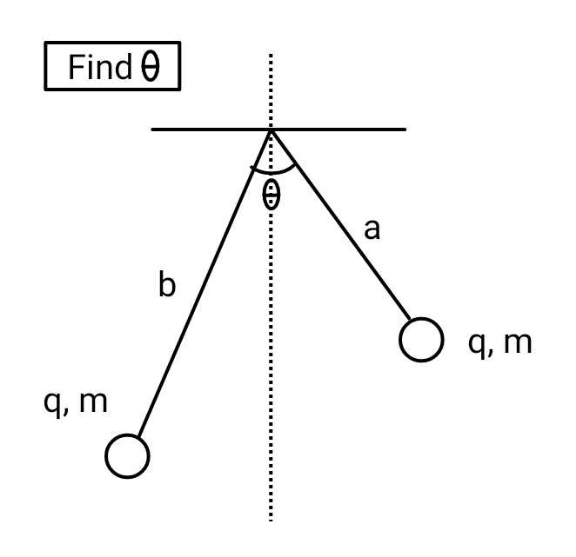
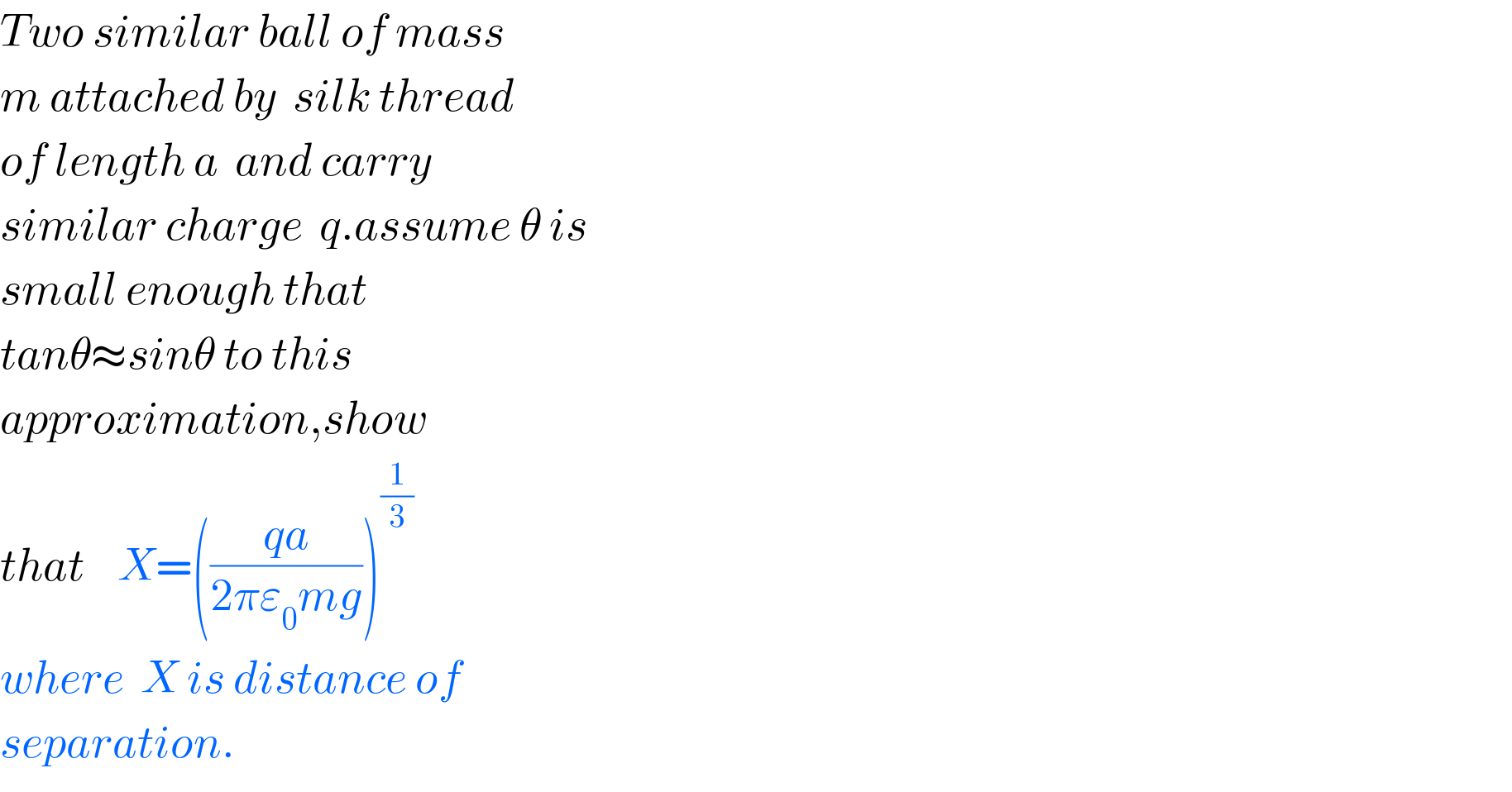
Two similar ball of mass
m attached by silk thread
of length a and carry
similar charge q.assume θ is
small enough that
tanθ≈sinθ to this
approximation,show
that X=(((qa)/(2πε_0 mg)))^(1/3)
where X is distance of
separation.
0
ans
0
cmts
Question 48489
1
ans
1
cmts
Question 48458
0
ans
7
cmts
Question 48405
1
ans
2
cmts
Question 47646
0
ans
0
cmts
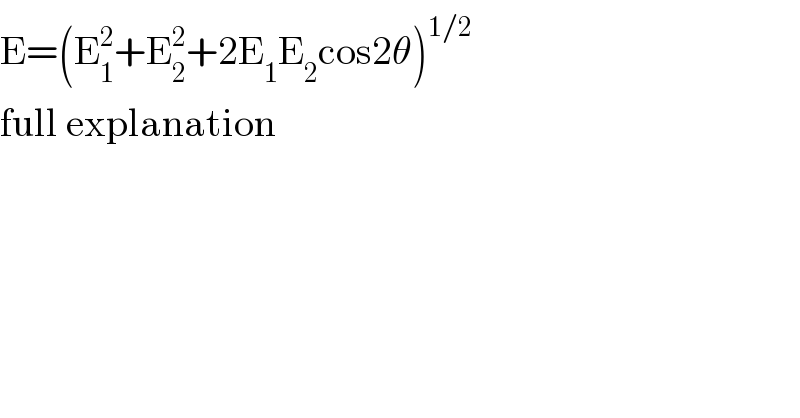
E=(E_1 ^2 +E_2 ^2 +2E_1 E_2 cos2θ)^(1/2)
full explanation
1
ans
1
cmts
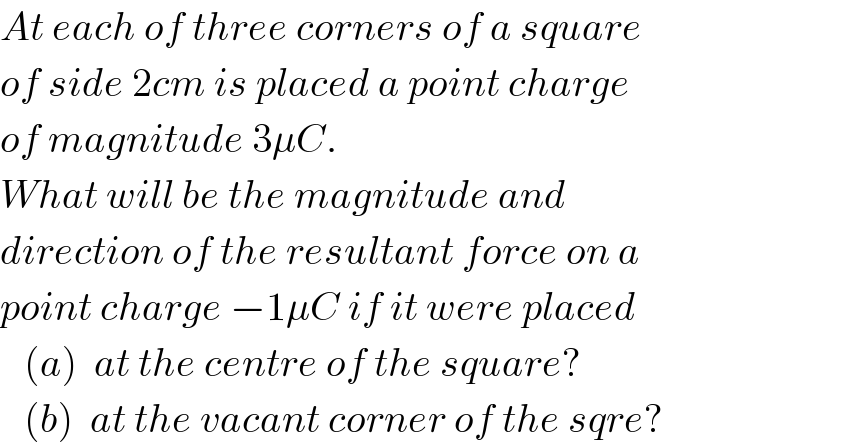
At each of three corners of a square
of side 2cm is placed a point charge
of magnitude 3μC.
What will be the magnitude and
direction of the resultant force on a
point charge −1μC if it were placed
(a) at the centre of the square?
(b) at the vacant corner of the sqre?
0
ans
1
cmts
Question 46293
1
ans
0
cmts
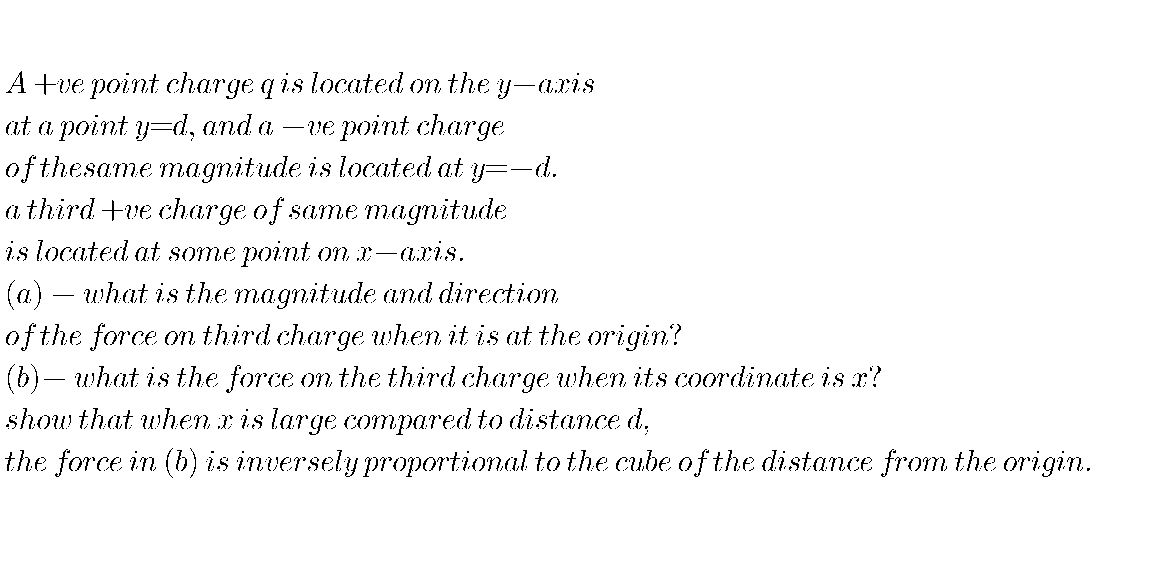
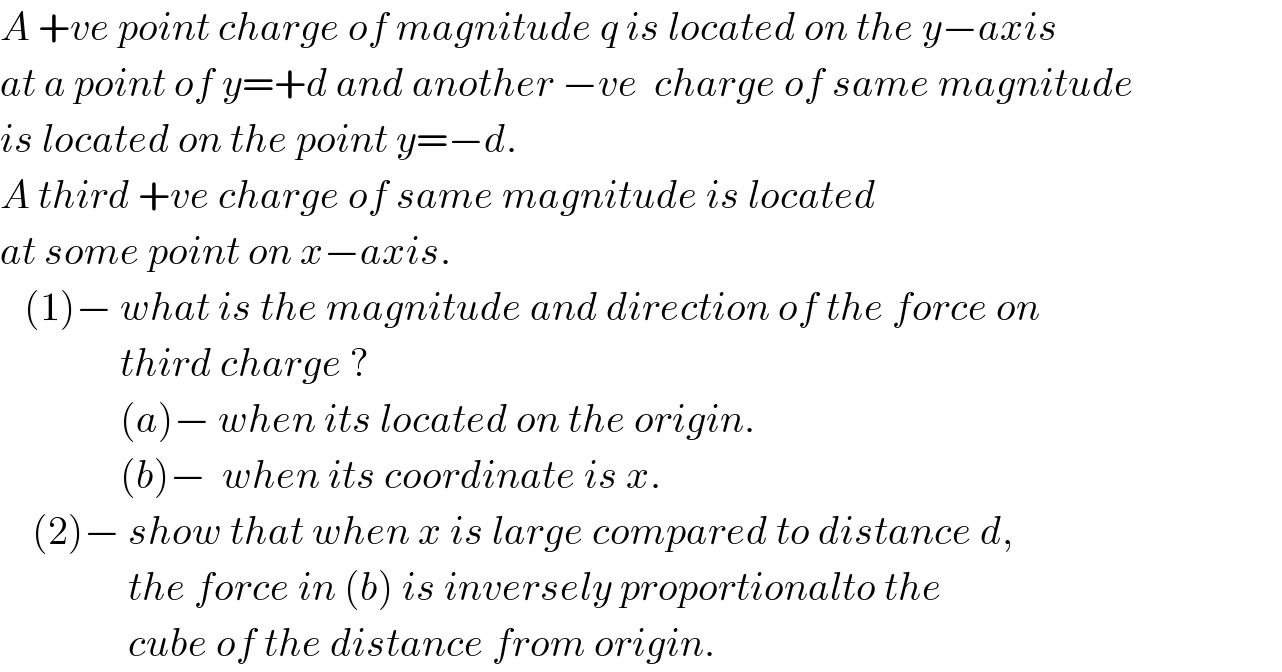
A +ve point charge of magnitude q is located on the y−axis
at a point of y=+d and another −ve charge of same magnitude
is located on the point y=−d.
A third +ve charge of same magnitude is located
at some point on x−axis.
(1)− what is the magnitude and direction of the force on
third charge ?
(a)− when its located on the origin.
(b)− when its coordinate is x.
(2)− show that when x is large compared to distance d,
the force in (b) is inversely proportionalto the
cube of the distance from origin.
1
ans
0
cmts
Question 41530