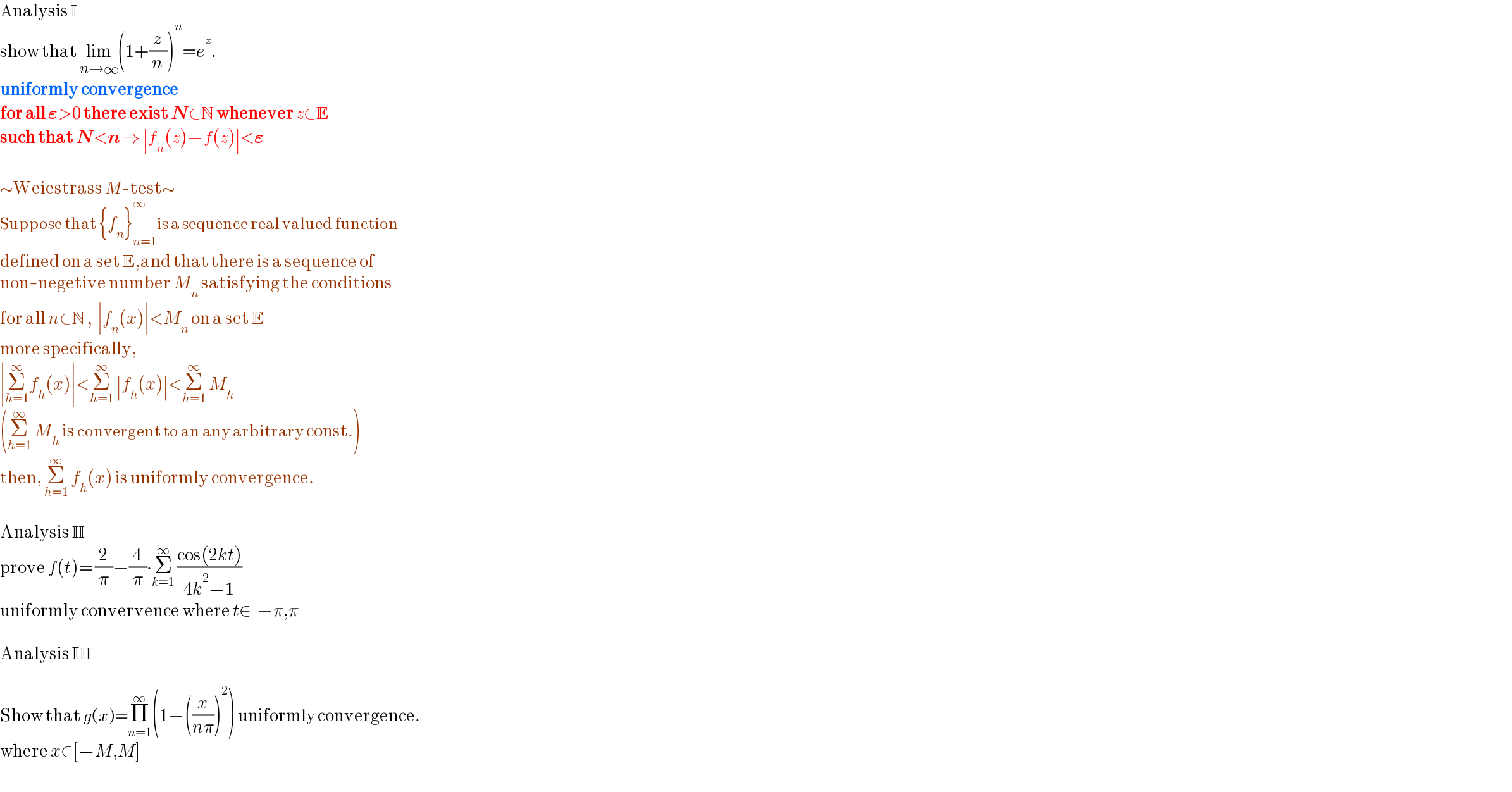
Analysis I
show that lim_(n→∞) (1+(z/n))^n =e^z .
uniformly convergence
for all 𝛜>0 there exist N∈N whenever z∈E
such that N<n ⇒ ∣f_n (z)−f(z)∣<𝛜
∼Weiestrass M-test∼
Suppose that {f_n ^ }_(n=1) ^∞ is a sequence real valued function
defined on a set E,and that there is a sequence of
non-negetive number M_n satisfying the conditions
for all n∈N , ∣f_n ^ (x)∣<M_n on a set E
more specifically,
∣Σ_(h=1) ^∞ f_h (x)∣<Σ_(h=1) ^∞ ∣f_h (x)∣<Σ_(h=1) ^∞ M_h
(Σ_(h=1) ^∞ M_h is convergent to an any arbitrary const.)
then, Σ_(h=1) ^∞ f_h (x) is uniformly convergence.
Analysis II
prove f(t)= (2/π)−(4/π)∙Σ_(k=1) ^∞ ((cos(2kt))/(4k^2 −1))
uniformly convervence where t∈[−π,π]
Analysis III
Show that g(x)=Π^∞ _(n=1) (1−((x/(nπ)))^2 ) uniformly convergence.
where x∈[−M,M]
0
Answers
No answers yet. Be the first to answer!
Know the answer? Share your knowledge!
📱 Answer on the App