

Question Number 216350 by deleted31 last updated on 05/Feb/25
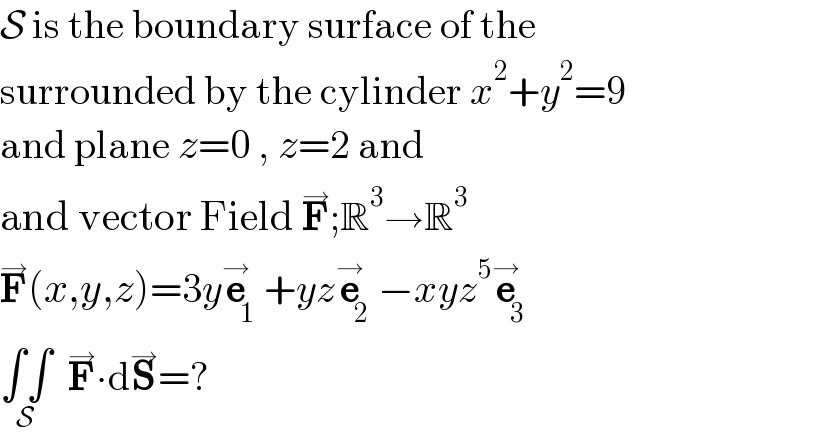
$$\mathcal{S}\:\mathrm{is}\:\mathrm{the}\:\mathrm{boundary}\:\mathrm{surface}\:\mathrm{of}\:\mathrm{the} \\ $$$$\mathrm{surrounded}\:\mathrm{by}\:\mathrm{the}\:\mathrm{cylinder}\:{x}^{\mathrm{2}} +{y}^{\mathrm{2}} =\mathrm{9} \\ $$$$\mathrm{and}\:\mathrm{plane}\:{z}=\mathrm{0}\:,\:{z}=\mathrm{2}\:\mathrm{and} \\ $$$$\mathrm{and}\:\mathrm{vector}\:\mathrm{Field}\:\overset{\rightarrow} {\boldsymbol{\mathrm{F}}};\mathbb{R}^{\mathrm{3}} \rightarrow\mathbb{R}^{\mathrm{3}} \\ $$$$\overset{\rightarrow} {\boldsymbol{\mathrm{F}}}\left({x},{y},{z}\right)=\mathrm{3}{y}\overset{\rightarrow} {\boldsymbol{\mathrm{e}}}_{\mathrm{1}} +{yz}\overset{\rightarrow} {\boldsymbol{\mathrm{e}}}_{\mathrm{2}} −{xyz}^{\mathrm{5}} \overset{\rightarrow} {\boldsymbol{\mathrm{e}}}_{\mathrm{3}} \\ $$$$\underset{\mathcal{S}} {\int\int}\:\:\overset{\rightarrow} {\boldsymbol{\mathrm{F}}}\centerdot\mathrm{d}\overset{\rightarrow} {\boldsymbol{\mathrm{S}}}=? \\ $$
Answered by MrGaster last updated on 06/Feb/25
![∫∫_S F^→ ∙dS^→ =∫∫∫_(V ) ▽∙F^→ dV ▽∙F^→ =(∂/∂x)(3y)+(∂/∂y)(yz)+(∂/∂z)(−xyz^5 )=0+z−5xyz^4 ∫∫∫_V (z−5xyz^4 )dV=∫_0 ^2 ∫_0 ^(2π) ∫_0 ^3 (r cos θ−5r^2 cosθz^4 )r dr dθ dz =∫_0 ^2 ∫_0 ^(2π) [(r^3 /3)cos θ−((5r^4 )/4)cos θz^4 ]_0 ^3 dθ dz =∫_0 ^2 ∫_0 ^(2π) (9 cos θ−((405)/4)cosθz^4 )dθ dz =∫_0 ^2 [9 sinθ−((405)/4)sin θz^4 ]_0 ^(2π) dz=0 ∫∫_S F^→ ∙dS^→ =0](Q216376.png)
$$\int\int_{\mathcal{S}} \overset{\rightarrow} {\boldsymbol{\mathrm{F}}}\centerdot{d}\overset{\rightarrow} {\boldsymbol{{S}}}=\int\int\int_{{V}\:} \bigtriangledown\centerdot\overset{\rightarrow} {\boldsymbol{\mathrm{F}}}{dV} \\ $$$$\bigtriangledown\centerdot\overset{\rightarrow} {\boldsymbol{{F}}}=\frac{\partial}{\partial{x}}\left(\mathrm{3}{y}\right)+\frac{\partial}{\partial{y}}\left({yz}\right)+\frac{\partial}{\partial{z}}\left(−{xyz}^{\mathrm{5}} \right)=\mathrm{0}+{z}−\mathrm{5}{xyz}^{\mathrm{4}} \\ $$$$\int\int\int_{{V}} \left({z}−\mathrm{5}{xyz}^{\mathrm{4}} \right){dV}=\int_{\mathrm{0}} ^{\mathrm{2}} \int_{\mathrm{0}} ^{\mathrm{2}\pi} \int_{\mathrm{0}} ^{\mathrm{3}} \left({r}\:\mathrm{cos}\:\theta−\mathrm{5}{r}^{\mathrm{2}} \mathrm{cos}\theta{z}^{\mathrm{4}} \right){r}\:{dr}\:{d}\theta\:\:{dz} \\ $$$$=\int_{\mathrm{0}} ^{\mathrm{2}} \int_{\mathrm{0}} ^{\mathrm{2}\pi} \left[\frac{{r}^{\mathrm{3}} }{\mathrm{3}}\mathrm{cos}\:\theta−\frac{\mathrm{5}{r}^{\mathrm{4}} }{\mathrm{4}}\mathrm{cos}\:\theta{z}^{\mathrm{4}} \right]_{\mathrm{0}} ^{\mathrm{3}} {d}\theta\:{dz} \\ $$$$=\int_{\mathrm{0}} ^{\mathrm{2}} \int_{\mathrm{0}} ^{\mathrm{2}\pi} \left(\mathrm{9}\:\mathrm{cos}\:\theta−\frac{\mathrm{405}}{\mathrm{4}}\mathrm{cos}\theta{z}^{\mathrm{4}} \right){d}\theta\:{dz} \\ $$$$=\int_{\mathrm{0}} ^{\mathrm{2}} \left[\mathrm{9}\:\mathrm{sin}\theta−\frac{\mathrm{405}}{\mathrm{4}}\mathrm{sin}\:\theta{z}^{\mathrm{4}} \right]_{\mathrm{0}} ^{\mathrm{2}\pi} {dz}=\mathrm{0} \\ $$$$\int\int_{\mathcal{S}} \overset{\rightarrow} {\boldsymbol{\mathrm{F}}}\centerdot{d}\overset{\rightarrow} {\boldsymbol{{S}}}=\mathrm{0} \\ $$