Question and Answers Forum

All Questions   Topic List

AllQuestion and Answers: Page 1726

Question Number 36126    Answers: 0   Comments: 4

x^4 +10x^3 +6x−1 =^(?) (x^2 +(((√5)−1)/2))(x^2 +10x−(((√5)+1)/2))

$$\mathrm{x}^{\mathrm{4}} +\mathrm{10x}^{\mathrm{3}} +\mathrm{6x}−\mathrm{1} \\ $$$$\:\:\:\:\:\:\:\:\:\:\:\:\:\:\:\overset{?} {=}\left({x}^{\mathrm{2}} +\frac{\sqrt{\mathrm{5}}−\mathrm{1}}{\mathrm{2}}\right)\left({x}^{\mathrm{2}} +\mathrm{10}{x}−\frac{\sqrt{\mathrm{5}}+\mathrm{1}}{\mathrm{2}}\right) \\ $$

Question Number 36120    Answers: 1   Comments: 0

3(√(200×1080))

$$\mathrm{3}\sqrt{\mathrm{200}×\mathrm{1080}} \\ $$

Question Number 36119    Answers: 0   Comments: 3

3(√(433^ ))

$$\mathrm{3}\sqrt{\mathrm{43}\hat {\mathrm{3}}} \\ $$

Question Number 36115    Answers: 0   Comments: 1

Question Number 36110    Answers: 0   Comments: 0

{Δ1 3 6 / ×<⌈+2/ 47

$$\left\{\Delta\mathrm{1}\:\mathrm{3}\:\mathrm{6}\:/\:×<\lceil+\mathrm{2}/\right. \\ $$$$\mathrm{47} \\ $$$$ \\ $$$$ \\ $$$$ \\ $$

Question Number 36104    Answers: 0   Comments: 1

If f:R→R is a function such that ∣ f(x) − f(y)∣ ≤ ∣ sin x − sin y ∣∀x,y∈R, Then f(x) is (1) Bijective (2) many−one (3) periodic (4) non−periodic

$$\mathrm{If}\:\boldsymbol{\mathrm{f}}:\boldsymbol{\mathrm{R}}\rightarrow\boldsymbol{\mathrm{R}}\:\mathrm{is}\:\mathrm{a}\:\mathrm{function}\:\mathrm{such}\:\mathrm{that} \\ $$$$\mid\:\mathrm{f}\left({x}\right)\:−\:\mathrm{f}\left(\mathrm{y}\right)\mid\:\leqslant\:\mid\:\mathrm{sin}\:{x}\:−\:\mathrm{sin}\:\mathrm{y}\:\mid\forall{x},\mathrm{y}\in\mathbb{R}, \\ $$$$\mathrm{Then}\:\mathrm{f}\left({x}\right)\:\mathrm{is}\: \\ $$$$\left(\mathrm{1}\right)\:\mathrm{Bijective} \\ $$$$\left(\mathrm{2}\right)\:\mathrm{many}−\mathrm{one} \\ $$$$\left(\mathrm{3}\right)\:\mathrm{periodic} \\ $$$$\left(\mathrm{4}\right)\:\mathrm{non}−\mathrm{periodic} \\ $$

Question Number 36103    Answers: 3   Comments: 0

convert 0.26999999...into fraction (a/b) where a≠0

$$\boldsymbol{\mathrm{convert}}\:\mathrm{0}.\mathrm{26999999}...\boldsymbol{\mathrm{into}}\:\boldsymbol{\mathrm{fraction}}\: \\ $$$$\frac{\boldsymbol{\mathrm{a}}}{\boldsymbol{\mathrm{b}}}\:\boldsymbol{\mathrm{where}}\:\boldsymbol{\mathrm{a}}\neq\mathrm{0} \\ $$

Question Number 36101    Answers: 2   Comments: 2

Question Number 36099    Answers: 0   Comments: 4

Question Number 36096    Answers: 1   Comments: 4

Question Number 36092    Answers: 1   Comments: 1

solve for 0°≤ θ ≤ 360° the equation cos(θ + (π/3))= (1/2)

$$\:\mathrm{solve}\:\mathrm{for}\:\mathrm{0}°\leqslant\:\theta\:\leqslant\:\mathrm{360}°\:\mathrm{the}\:\mathrm{equation} \\ $$$$\:\mathrm{cos}\left(\theta\:+\:\frac{\pi}{\mathrm{3}}\right)=\:\frac{\mathrm{1}}{\mathrm{2}} \\ $$

Question Number 36091    Answers: 0   Comments: 1

Given the position vectors v_1 = 2i − 2j and v_2 = 2j, show that the unit vector in the direction of the vector v_1 − v_(2 ) is (1/(√5))(i−2j)

$$\mathrm{Given}\:\mathrm{the}\:\mathrm{position}\:\mathrm{vectors} \\ $$$${v}_{\mathrm{1}} =\:\mathrm{2}{i}\:−\:\mathrm{2}{j}\:{and}\:{v}_{\mathrm{2}} =\:\mathrm{2}{j}, \\ $$$$\mathrm{show}\:\mathrm{that}\:\mathrm{the}\:\mathrm{unit}\:\mathrm{vector}\:\mathrm{in}\: \\ $$$$\mathrm{the}\:\mathrm{direction}\:\mathrm{of}\:\mathrm{the}\:\mathrm{vector}\: \\ $$$${v}_{\mathrm{1}} −\:{v}_{\mathrm{2}\:\:\:} \mathrm{is}\:\frac{\mathrm{1}}{\sqrt{\mathrm{5}}}\left(\mathrm{i}−\mathrm{2j}\right) \\ $$

Question Number 36080    Answers: 2   Comments: 1

i want to know how α^2 + β^2 = (α+β)^2 − 2αβ why not α^2 +β^2 = (α+β)^2 + 2αβ?

$$\:\mathrm{i}\:\mathrm{want}\:\mathrm{to}\:\mathrm{know}\:\mathrm{how}\: \\ $$$$\alpha^{\mathrm{2}} +\:\beta^{\mathrm{2}} =\:\left(\alpha+\beta\right)^{\mathrm{2}} −\:\mathrm{2}\alpha\beta\:\mathrm{why}\:\mathrm{not}\: \\ $$$$\alpha^{\mathrm{2}} +\beta^{\mathrm{2}} =\:\left(\alpha+\beta\right)^{\mathrm{2}} +\:\mathrm{2}\alpha\beta? \\ $$

Question Number 36068    Answers: 0   Comments: 1

Why is it not advisable to use small incident angle when performing experiment on refraction using a triangular prism?

$${Why}\:{is}\:{it}\:{not}\:{advisable}\:{to}\:{use} \\ $$$${small}\:{incident}\:{angle}\:{when}\:{performing} \\ $$$${experiment}\:{on}\:{refraction}\:{using}\:{a} \\ $$$${triangular}\:{prism}? \\ $$

Question Number 36061    Answers: 1   Comments: 2

Question Number 36059    Answers: 1   Comments: 0

Question Number 36057    Answers: 2   Comments: 1

find the value of ∫_0 ^(π/4) ((cosx)/(sinx +tanx))dx

$${find}\:{the}\:{value}\:{of}\:\:\int_{\mathrm{0}} ^{\frac{\pi}{\mathrm{4}}} \:\:\:\:\frac{{cosx}}{{sinx}\:+{tanx}}{dx}\: \\ $$

Question Number 36056    Answers: 1   Comments: 2

calculate ∫_(−∞) ^(+∞) ((2x)/((x^2 +mx +1)^2 ))dx with ∣m∣<2

$${calculate}\:\:\int_{−\infty} ^{+\infty} \:\:\:\frac{\mathrm{2}{x}}{\left({x}^{\mathrm{2}} \:+{mx}\:+\mathrm{1}\right)^{\mathrm{2}} }{dx}\:{with}\:\mid{m}\mid<\mathrm{2} \\ $$

Question Number 36049    Answers: 0   Comments: 0

A triangle △ABC is constructed such that ∠B= 90° and AB= 5cm Given that ∠C= 45° . show that the point (2,0) lie on the line BC and is perpendicular to AB but meet at 45^ ° with the line AC.

$$\mathrm{A}\:\mathrm{triangle}\:\bigtriangleup\mathrm{ABC}\:\mathrm{is}\:\mathrm{constructed}\: \\ $$$$\mathrm{such}\:\mathrm{that}\:\angle\mathrm{B}=\:\mathrm{90}°\:\:\mathrm{and}\:\mathrm{AB}=\:\mathrm{5cm} \\ $$$$\mathrm{Given}\:\mathrm{that}\:\angle\mathrm{C}=\:\mathrm{45}°\:.\:\mathrm{show}\:\mathrm{that} \\ $$$$\:\mathrm{the}\:\mathrm{point}\:\left(\mathrm{2},\mathrm{0}\right)\:\mathrm{lie}\:\mathrm{on}\:\mathrm{the}\:\mathrm{line}\: \\ $$$$\mathrm{BC}\:\mathrm{and}\:\mathrm{is}\:\mathrm{perpendicular}\:\mathrm{to}\:\mathrm{AB}\:\mathrm{but} \\ $$$$\mathrm{meet}\:\mathrm{at}\:\mathrm{45}^{} °\:\mathrm{with}\:\mathrm{the}\:\mathrm{line}\:\mathrm{AC}. \\ $$$$ \\ $$

Question Number 36034    Answers: 1   Comments: 1

Question Number 36031    Answers: 0   Comments: 0

Q. Evaluate: ∫_(∫xyzdxdydz) ^(∫zyxdzdydx) ∫_((d/dx)(x^(sin x) )) ^((d/dx)(x^(cos x) )) ∫_(lim_(x→0) ((−x^2 +2)/x)) ^(lim_(x→0) ((x^2 −2)/x)) ∫_0 ^∞ w^(1−x) x^(1−y) y^(1−z) z^(1−w) dwdxdydz

$$\mathrm{Q}.\:\mathrm{Evaluate}:\:\:\:\int_{\int\mathrm{xyzdxdydz}} ^{\int\mathrm{zyxdzdydx}} \int_{\frac{\mathrm{d}}{\mathrm{dx}}\left(\mathrm{x}^{\mathrm{sin}\:\mathrm{x}} \right)} ^{\frac{\mathrm{d}}{\mathrm{dx}}\left(\mathrm{x}^{\mathrm{cos}\:\mathrm{x}} \right)} \int_{\underset{{x}\rightarrow\mathrm{0}} {\mathrm{lim}}\frac{−\mathrm{x}^{\mathrm{2}} +\mathrm{2}}{\mathrm{x}}} ^{\underset{{x}\rightarrow\mathrm{0}} {\mathrm{lim}}\frac{\mathrm{x}^{\mathrm{2}} −\mathrm{2}}{\mathrm{x}}} \int_{\mathrm{0}} ^{\infty} \mathrm{w}^{\mathrm{1}−\mathrm{x}} \mathrm{x}^{\mathrm{1}−\mathrm{y}} \mathrm{y}^{\mathrm{1}−\mathrm{z}} \mathrm{z}^{\mathrm{1}−\mathrm{w}} \mathrm{dwdxdydz} \\ $$

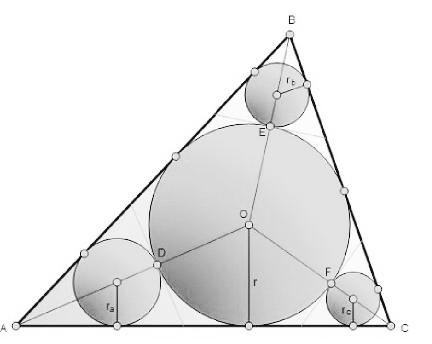
Question Number 36030    Answers: 1   Comments: 1

Q. What will be the expression for area of sphere? If the area of cube is 4πr^2 . And all sides of cube touches the sphere.

$$\mathrm{Q}.\:\mathrm{What}\:\mathrm{will}\:\mathrm{be}\:\mathrm{the}\:\mathrm{expression}\:\mathrm{for}\:\mathrm{area}\:\mathrm{of}\:\mathrm{sphere}?\: \\ $$$$\:\:\:\:\:\:\:\:\mathrm{If}\:\mathrm{the}\:\mathrm{area}\:\mathrm{of}\:\mathrm{cube}\:\mathrm{is}\:\mathrm{4}\pi\mathrm{r}^{\mathrm{2}} .\:\mathrm{And}\:\mathrm{all}\:\mathrm{sides}\:\mathrm{of}\:\mathrm{cube}\:\mathrm{touches}\:\mathrm{the}\:\mathrm{sphere}. \\ $$

Question Number 36024    Answers: 1   Comments: 2

Question Number 36021    Answers: 0   Comments: 0

Prove that the hypotenuse never be even of a right angled triangle whose positive integer sides are relatively prime.

$$\mathrm{Prove}\:\mathrm{that}\:\mathrm{the}\:\mathrm{hypotenuse}\:\mathrm{never}\:\mathrm{be} \\ $$$$\mathrm{even}\:\mathrm{of}\:\mathrm{a}\:\mathrm{right}\:\mathrm{angled}\:\mathrm{triangle}\:\mathrm{whose} \\ $$$$\mathrm{positive}\:\mathrm{integer}\:\mathrm{sides}\:\mathrm{are}\:\mathrm{relatively}\:\mathrm{prime}. \\ $$

Question Number 36019    Answers: 3   Comments: 0

If a+b+c=0 show that ((a/(b−c))+(b/(c−a))+(c/(a−b)))(((b−c)/a)+((c−a)/b) +((a−b)/c))=9

$${If}\:{a}+{b}+{c}=\mathrm{0}\:{show}\:{that} \\ $$$$\left(\frac{{a}}{{b}−{c}}+\frac{{b}}{{c}−{a}}+\frac{{c}}{{a}−{b}}\right)\left(\frac{{b}−{c}}{{a}}+\frac{{c}−{a}}{{b}}\:+\frac{{a}−{b}}{{c}}\right)=\mathrm{9} \\ $$

Question Number 36018    Answers: 1   Comments: 0

Find the value of lim_(x→(π/2)) ((sinx−(sinx)^(sinx) )/(1−sinx+lnsinx))

$${Find}\:{the}\:{value}\:{of} \\ $$$$\underset{{x}\rightarrow\frac{\pi}{\mathrm{2}}} {{lim}}\:\frac{{sinx}−\left({sinx}\right)^{{sinx}} }{\mathrm{1}−{sinx}+{lnsinx}} \\ $$

  Pg 1721      Pg 1722      Pg 1723      Pg 1724      Pg 1725      Pg 1726      Pg 1727      Pg 1728      Pg 1729      Pg 1730   

Terms of Service

Privacy Policy

Contact: info@tinkutara.com