Question and Answers Forum

All Questions   Topic List

AllQuestion and Answers: Page 1503

Question Number 60765    Answers: 0   Comments: 2

express in partial fraction 14/(x^2 +3)(x+2)

$${express}\:{in}\:{partial}\:{fraction}\:\mathrm{14}/\left({x}^{\mathrm{2}} +\mathrm{3}\right)\left({x}+\mathrm{2}\right) \\ $$

Question Number 60756    Answers: 1   Comments: 1

express in partial fraction 5/(x−2)(x+3)^2

$${express}\:{in}\:{partial}\:{fraction}\:\mathrm{5}/\left({x}−\mathrm{2}\right)\left({x}+\mathrm{3}\right)^{\mathrm{2}} \\ $$

Question Number 60748    Answers: 1   Comments: 1

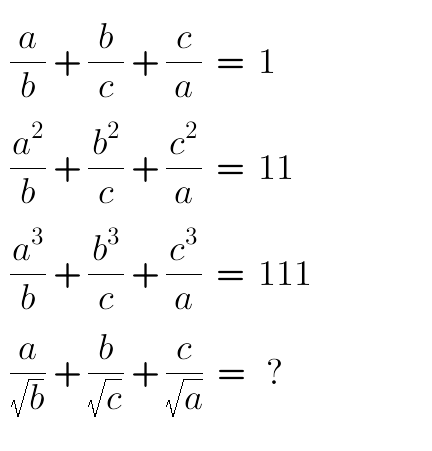
Question Number 60745    Answers: 4   Comments: 5

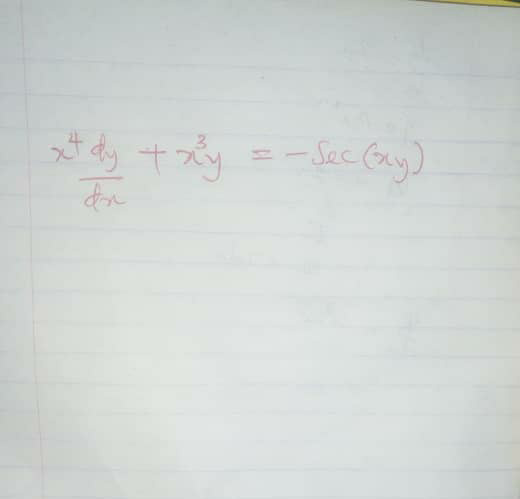
Question Number 60739    Answers: 1   Comments: 4

evaluate i.∫ (((x+1)/(x−1)))dx ii. ∫_0 ^π (2cosxsinx)dx iii. ∫_((π/(3 )) ) ^π (((sin2x)/(cos2x)))dx

$${evaluate}\:\: \\ $$$${i}.\int\:\left(\frac{{x}+\mathrm{1}}{{x}−\mathrm{1}}\right){dx} \\ $$$${ii}.\:\:\int_{\mathrm{0}} ^{\pi} \left(\mathrm{2}{cosxsinx}\right){dx}\:\: \\ $$$${iii}.\:\:\int_{\frac{\pi}{\mathrm{3}\:}\:} ^{\pi} \left(\frac{{sin}\mathrm{2}{x}}{{cos}\mathrm{2}{x}}\right){dx} \\ $$

Question Number 60735    Answers: 3   Comments: 0

express in partial fraction 3/(x+1)(x^2 −4)

$${express}\:{in}\:{partial}\:{fraction}\:\mathrm{3}/\left({x}+\mathrm{1}\right)\left({x}^{\mathrm{2}} −\mathrm{4}\right) \\ $$

Question Number 60734    Answers: 1   Comments: 4

Find the product of the real roots of the equation (x + 2 + (√(x^2 + 4x + 3)))^5 − 32(x + 2 − (√(x^2 + 4x + 3)))^5 = 31

$$\mathrm{Find}\:\mathrm{the}\:\mathrm{product}\:\mathrm{of}\:\mathrm{the}\:\mathrm{real}\:\mathrm{roots}\:\mathrm{of}\:\mathrm{the}\:\mathrm{equation} \\ $$$$\:\:\:\:\:\:\:\:\:\left(\mathrm{x}\:+\:\mathrm{2}\:+\:\sqrt{\mathrm{x}^{\mathrm{2}} \:+\:\mathrm{4x}\:+\:\mathrm{3}}\right)^{\mathrm{5}} \:−\:\:\mathrm{32}\left(\mathrm{x}\:+\:\mathrm{2}\:−\:\sqrt{\mathrm{x}^{\mathrm{2}} \:+\:\mathrm{4x}\:+\:\mathrm{3}}\right)^{\mathrm{5}} \:\:=\:\:\mathrm{31} \\ $$

Question Number 60731    Answers: 0   Comments: 0

Question Number 60728    Answers: 0   Comments: 0

calculate ∫_1 ^(+∞) ((ln(lnx))/(x^2 −x +1))dx

$${calculate}\:\int_{\mathrm{1}} ^{+\infty} \:\:\frac{{ln}\left({lnx}\right)}{{x}^{\mathrm{2}} −{x}\:+\mathrm{1}}{dx} \\ $$

Question Number 60727    Answers: 0   Comments: 2

calculate ∫_1 ^(+∞) ((ln(lnx))/(1+x^2 ))dx

$${calculate}\:\int_{\mathrm{1}} ^{+\infty} \:\frac{{ln}\left({lnx}\right)}{\mathrm{1}+{x}^{\mathrm{2}} }{dx} \\ $$

Question Number 60725    Answers: 0   Comments: 2

x = Σ_(0≤i≤j≤2019) ( _( j)^(2019) )( _i^j )

$${x}\:\:=\:\:\underset{\mathrm{0}\leqslant{i}\leqslant{j}\leqslant\mathrm{2019}} {\sum}\:\left(\:_{\:\:\:\:{j}} ^{\mathrm{2019}} \:\right)\left(\:\:_{{i}} ^{{j}} \:\:\right)\: \\ $$

Question Number 60723    Answers: 0   Comments: 10

solve for x (√(a−(√(a+x)))) + (√(a+(√(a−x)))) = 2x

$${solve}\:{for}\:{x}\: \\ $$$$\sqrt{{a}−\sqrt{{a}+{x}}}\:+\:\sqrt{{a}+\sqrt{{a}−{x}}}\:=\:\mathrm{2}{x} \\ $$

Question Number 60717    Answers: 0   Comments: 1

Question Number 60706    Answers: 0   Comments: 2

let f(x) =(√(1+x^2 )) 1) let U_n =f^((n)) (x) prove that Σ_(k=0) ^n C_n ^k U_k U_(n+1−k) =0 for n≥2 2) developp f at integr serie .

$${let}\:{f}\left({x}\right)\:=\sqrt{\mathrm{1}+{x}^{\mathrm{2}} } \\ $$$$\left.\mathrm{1}\right)\:{let}\:{U}_{{n}} ={f}^{\left({n}\right)} \left({x}\right)\:\:{prove}\:{that}\:\sum_{{k}=\mathrm{0}} ^{{n}} \:{C}_{{n}} ^{{k}} \:{U}_{{k}} {U}_{{n}+\mathrm{1}−{k}} =\mathrm{0}\:\:{for}\:{n}\geqslant\mathrm{2} \\ $$$$\left.\mathrm{2}\right)\:{developp}\:{f}\:{at}\:{integr}\:{serie}\:. \\ $$

Question Number 60705    Answers: 1   Comments: 0

Question Number 60716    Answers: 1   Comments: 1

Question Number 60702    Answers: 0   Comments: 0

Question Number 60701    Answers: 0   Comments: 1

let f(x) =e^(−x^2 ) ln(2−x) developp f at integr serie .

$${let}\:{f}\left({x}\right)\:={e}^{−{x}^{\mathrm{2}} } {ln}\left(\mathrm{2}−{x}\right)\:\:\:{developp}\:{f}\:{at}\:{integr}\:{serie}\:. \\ $$

Question Number 60697    Answers: 1   Comments: 1

Question Number 60695    Answers: 0   Comments: 1

solve (√(3+x^2 ))y^(′′) −(2x+1)y^′ =x^2 e^(−x^2 )

$${solve}\:\sqrt{\mathrm{3}+{x}^{\mathrm{2}} }{y}^{''} \:\:\:\:−\left(\mathrm{2}{x}+\mathrm{1}\right){y}^{'} \:={x}^{\mathrm{2}} \:{e}^{−{x}^{\mathrm{2}} \:\:\:} \\ $$

Question Number 60694    Answers: 0   Comments: 0

solve (x^3 −x)y^(′′) −2x y^′ +3y =xln(1+x)

$${solve}\:\:\left({x}^{\mathrm{3}} −{x}\right){y}^{''} \:\:\:−\mathrm{2}{x}\:{y}^{'} \:+\mathrm{3}{y}\:={xln}\left(\mathrm{1}+{x}\right) \\ $$

Question Number 60693    Answers: 0   Comments: 0

solve (2+e^(−x) )y^′ +(2x+e^x )y =e^x sinx

$${solve}\:\:\left(\mathrm{2}+{e}^{−{x}} \right){y}^{'} \:\:+\left(\mathrm{2}{x}+{e}^{{x}} \right){y}\:={e}^{{x}} {sinx}\: \\ $$

Question Number 60692    Answers: 0   Comments: 0

find ∫ arctan(2cosx)dx

$${find}\:\:\int\:\:{arctan}\left(\mathrm{2}{cosx}\right){dx}\: \\ $$

Question Number 60691    Answers: 0   Comments: 1

calculate f(a) = ∫ (1−(a/x^2 )) arctan(x+(a/x))dx with a real .

$${calculate}\:{f}\left({a}\right)\:=\:\int\:\:\:\left(\mathrm{1}−\frac{{a}}{{x}^{\mathrm{2}} }\right)\:{arctan}\left({x}+\frac{{a}}{{x}}\right){dx}\:\:\:{with}\:{a}\:{real}\:. \\ $$

Question Number 60690    Answers: 0   Comments: 0

find ∫ (x+3)(√((1−x^2 )/(1+x^2 )))dx

$${find}\:\int\:\left({x}+\mathrm{3}\right)\sqrt{\frac{\mathrm{1}−{x}^{\mathrm{2}} }{\mathrm{1}+{x}^{\mathrm{2}} }}{dx}\: \\ $$

Question Number 60688    Answers: 0   Comments: 0

find ∫ e^(−x) (√((3−x)/(3+x)))dx

$${find}\:\int\:\:\:{e}^{−{x}} \sqrt{\frac{\mathrm{3}−{x}}{\mathrm{3}+{x}}}{dx} \\ $$

  Pg 1498      Pg 1499      Pg 1500      Pg 1501      Pg 1502      Pg 1503      Pg 1504      Pg 1505      Pg 1506      Pg 1507   

Terms of Service

Privacy Policy

Contact: info@tinkutara.com