

Question Number 218771 by deleted50 last updated on 15/Apr/25
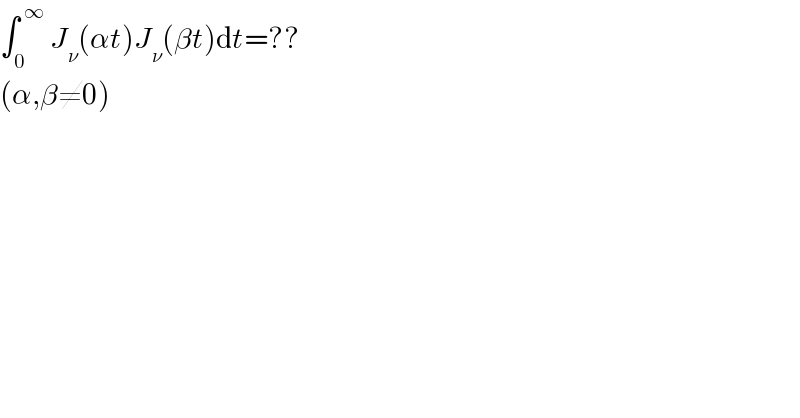
$$\int_{\mathrm{0}} ^{\:\infty} \:{J}_{\nu} \left(\alpha{t}\right){J}_{\nu} \left(\beta{t}\right)\mathrm{d}{t}=?? \\ $$$$\left(\alpha,\beta\neq\mathrm{0}\right) \\ $$
Answered by Nicholas666 last updated on 16/Apr/25
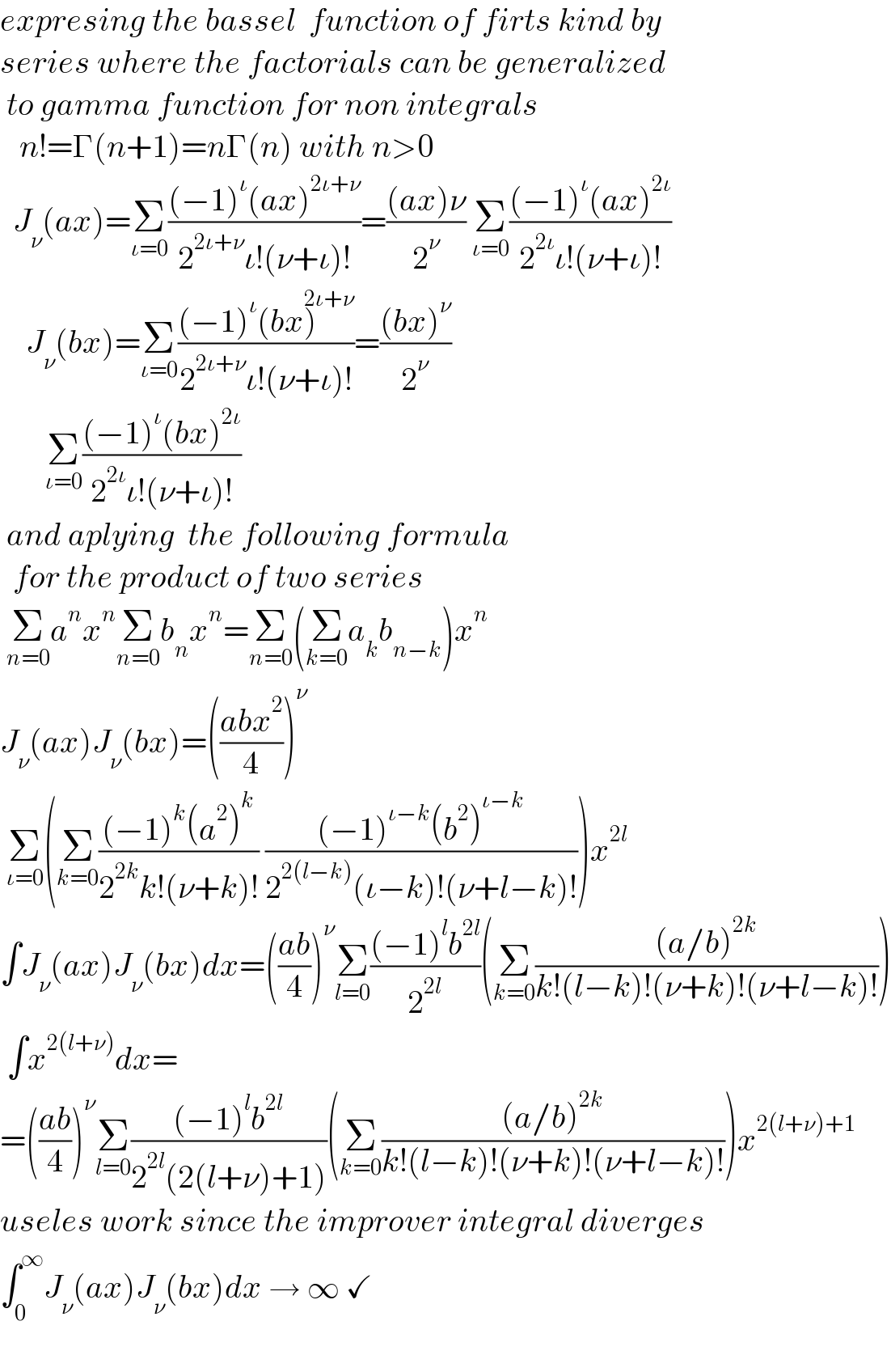
$${expresing}\:{the}\:{bassel}\:\:{function}\:{of}\:{firts}\:{kind}\:{by}\:\: \\ $$$${series}\:{where}\:{the}\:{factorials}\:{can}\:{be}\:{generalized}\: \\ $$$$\:{to}\:{gamma}\:{function}\:{for}\:{non}\:{integrals}\:\:\:\:\:\: \\ $$$$\:\:\:{n}!=\Gamma\left({n}+\mathrm{1}\right)={n}\Gamma\left({n}\right)\:{with}\:{n}>\mathrm{0} \\ $$$$\:\:{J}_{\nu} \left({ax}\right)=\underset{\iota=\mathrm{0}} {\sum}\frac{\left(−\mathrm{1}\right)^{\iota} \left({ax}\right)^{\mathrm{2}\iota+\nu} }{\mathrm{2}^{\mathrm{2}\iota+\nu} \iota!\left(\nu+\iota\right)!}=\frac{\left({ax}\right)\nu}{\mathrm{2}^{\nu} }\:\underset{\iota=\mathrm{0}} {\sum}\frac{\left(−\mathrm{1}\right)^{\iota} \left({ax}\right)^{\mathrm{2}\iota} }{\mathrm{2}^{\mathrm{2}\iota} \iota!\left(\nu+\iota\right)!}\:\:\:\:\:\:\:\:\: \\ $$$$\:\:\:\:{J}_{\nu} \left({bx}\right)=\underset{\iota=\mathrm{0}} {\sum}\frac{\left(−\mathrm{1}\right)^{\iota} \left({bx}\overset{\mathrm{2}\iota+\nu} {\right)}}{\mathrm{2}^{\mathrm{2}\iota+\nu} \iota!\left(\nu+\iota\right)!}=\frac{\left({bx}\right)^{\nu} }{\mathrm{2}^{\nu} } \\ $$$$\:\:\:\:\:\:\:\underset{\iota=\mathrm{0}} {\sum}\frac{\left(−\mathrm{1}\right)^{\iota} \left({bx}\right)^{\mathrm{2}\iota} }{\mathrm{2}^{\mathrm{2}\iota} \iota!\left(\nu+\iota\right)!} \\ $$$$\:{and}\:{aplying}\:\:{the}\:{following}\:{formula}\: \\ $$$$\:\:{for}\:{the}\:{product}\:{of}\:{two}\:{series} \\ $$$$\:\underset{{n}=\mathrm{0}} {\sum}{a}^{{n}} {x}^{{n}} \underset{{n}=\mathrm{0}} {\sum}{b}_{{n}} {x}^{{n}} =\underset{{n}=\mathrm{0}} {\sum}\left(\underset{{k}=\mathrm{0}} {\sum}{a}_{{k}} {b}_{{n}−{k}} \right){x}^{{n}} \\ $$$${J}_{\nu} \left({ax}\right){J}_{\nu} \left({bx}\right)=\left(\frac{{abx}^{\mathrm{2}} }{\mathrm{4}}\right)^{\nu} \\ $$$$\:\underset{\iota=\mathrm{0}} {\sum}\left(\underset{{k}=\mathrm{0}} {\sum}\frac{\left(−\mathrm{1}\right)^{{k}} \left({a}^{\mathrm{2}} \right)^{{k}} }{\mathrm{2}^{\mathrm{2}{k}} {k}!\left(\nu+{k}\right)!}\:\frac{\left(−\mathrm{1}\right)^{\iota−{k}} \left({b}^{\mathrm{2}} \right)^{\iota−{k}} }{\mathrm{2}^{\mathrm{2}\left({l}−{k}\right)} \left(\iota−{k}\right)!\left(\nu+{l}−{k}\right)!}\right){x}^{\mathrm{2}{l}} \\ $$$$\int{J}_{\nu} \left({ax}\right){J}_{\nu} \left({bx}\right){dx}=\left(\frac{{ab}}{\mathrm{4}}\right)^{\nu} \underset{{l}=\mathrm{0}} {\sum}\frac{\left(−\mathrm{1}\right)^{{l}} {b}^{\mathrm{2}{l}} }{\mathrm{2}^{\mathrm{2}{l}} }\left(\underset{{k}=\mathrm{0}} {\sum}\frac{\left({a}/{b}\right)^{\mathrm{2}{k}} }{{k}!\left({l}−{k}\right)!\left(\nu+{k}\right)!\left(\nu+{l}−{k}\right)!}\right) \\ $$$$\:\int{x}^{\mathrm{2}\left({l}+\nu\right)} {dx}= \\ $$$$=\left(\frac{{ab}}{\mathrm{4}}\right)^{\nu} \underset{{l}=\mathrm{0}} {\sum}\frac{\left(−\mathrm{1}\right)^{{l}} {b}^{\mathrm{2}{l}} }{\mathrm{2}^{\mathrm{2}{l}} \left(\mathrm{2}\left({l}+\nu\right)+\mathrm{1}\right)}\left(\underset{{k}=\mathrm{0}} {\sum}\frac{\left({a}/{b}\right)^{\mathrm{2}{k}} }{{k}!\left({l}−{k}\right)!\left(\nu+{k}\right)!\left(\nu+{l}−{k}\right)!}\right){x}^{\mathrm{2}\left({l}+\nu\right)+\mathrm{1}\:\:} \\ $$$${useles}\:{work}\:{since}\:{the}\:{improver}\:{integral}\:{diverges}\:\:\: \\ $$$$\int_{\mathrm{0}\:} ^{\infty} {J}_{\nu} \left({ax}\right){J}_{\nu} \left({bx}\right){dx}\:\rightarrow\:\infty\:\checkmark \\ $$$$ \\ $$